

1z1-809 Exam Dumps Pass with Updated Oct-2025 Tests Dumps
1z1-809 exam questions for practice in 2025 Updated 209 Questions
Difficulty in writing 1Z0-809 Exam
Oracle Certified Java Programmer is the most powerful certification that candidates can have on their resume. But for this, they will have to pass Oracle 1Z0-809 questions. Oracle 1Z0-809 is a challenging exam to pass this exam Candidates will have to work hard with the help of right focus and preparation material passing this exam is an achievable goal. ActualCollection help candidates by providing the most relevant and updated Oracle 1Z0-809 exam dumps. Furthermore, We also provide the Oracle 1Z0-809 practice test that will be much beneficial in the preparation. ActualCollection aims to provide the best Oracle 1Z0-809 exam dumps that is verified by the Oracle experts. If Candidates feel any doubt in the Oracle 1Z0-809 practice test then our team is always there to help them. Oracle 1Z0-809 exam dumps are the perfect way to prepare Oracle 1Z0-809 exam with good grades in the just first attempt. So, Candidates want instant success in the Oracle 1Z0-809 exam with quality Oracle 1Z0-809 training material then ActualCollection is the best option for them because our management is well trained in it and we update each question of all exams on regular basis after consulting recent updates with our Oracle certified professionals.
To prepare for the exam, candidates need to have a good understanding of Java SE 8 features and their applications. They should also be familiar with Java development tools and frameworks, such as Eclipse, Maven, and Spring. There are many resources available to help candidates prepare for the exam, including online courses, study guides, practice tests, and forums.
NEW QUESTION # 53
Given:
public class SampleClass {
public static void main(String[] args) {
AnotherSampleClass asc = new AnotherSampleClass(); SampleClass sc = new SampleClass(); sc = asc; System.out.println("sc: " + sc.getClass()); System.out.println("asc: " + asc.getClass());
}}
class AnotherSampleClass extends SampleClass {
}
What is the result?
- A. sc: class AnotherSampleClass
asc: class AnotherSampleClass - B. sc: class Object
asc: class AnotherSampleClass - C. sc: class SampleClass
asc: class AnotherSampleClass - D. sc: class AnotherSampleClass
asc: class SampleClass
Answer: A
NEW QUESTION # 54
Given the code fragments:
class ThreadRunner implements Runnable {
public void run () { System.out.print ("Runnable") ; }
}
class ThreadCaller implements Callable {
Public String call () throws Exception {return "Callable"; )
}
and
ExecutorService es = Executors.newCachedThreadPool ();
Runnable r1 = new ThreadRunner ();
Callable c1 = new ThreadCaller ();
// line n1
es.shutdown();
Which code fragment can be inserted at line n1to start r1and c1 threads?
- A. es.submit(r1);
Future<String> f1 = es.submit (c1); - B. Future<String> f1 = (Future<String>) es.execute(r1);
Future<String> f2 = (Future<String>) es.execute(c1); - C. Future<String> f1 = (Future<String>) es.submit (r1);
es.execute (c1); - D. es.execute (r1);
Future<String> f1 = es.execute (c1) ;
Answer: A
NEW QUESTION # 55
Given the code fragments:
class Employee {
Optional<Address> address;
Employee (Optional<Address> address) {
this.address = address;
}
public Optional<Address> getAddress() { return address; }
}
class Address {
String city = "New York";
public String getCity { return city: }
public String toString() {
return city;
}
}
and
Address address = null;
Optional<Address> addrs1 = Optional.ofNullable (address);
Employee e1 = new Employee (addrs1);
String eAddress = (addrs1.isPresent()) ? addrs1.get().getCity() : "City Not
available";
What is the result?
- A. New York
- B. City Not available
- C. A NoSuchElementException is thrown at run time.
- D. null
Answer: B
NEW QUESTION # 56
Given the code fragment:
ZonedDateTime depart = ZonedDateTime.of(2015, 1, 15, 3, 0, 0, 0, ZoneID.of("UTC-
7"));
ZonedDateTime arrive = ZonedDateTime.of(2015, 1, 15, 9, 0, 0, 0, ZoneID.of("UTC-
5"));
long hrs = ChronoUnit.HOURS.between(depart, arrive); //line n1
System.out.println("Travel time is" + hrs + "hours");
What is the result?
- A. Travel time is 6 hours
- B. Travel time is 4 hours
- C. An exception is thrown at line n1.
- D. Travel time is 8 hours
Answer: B
NEW QUESTION # 57
Given: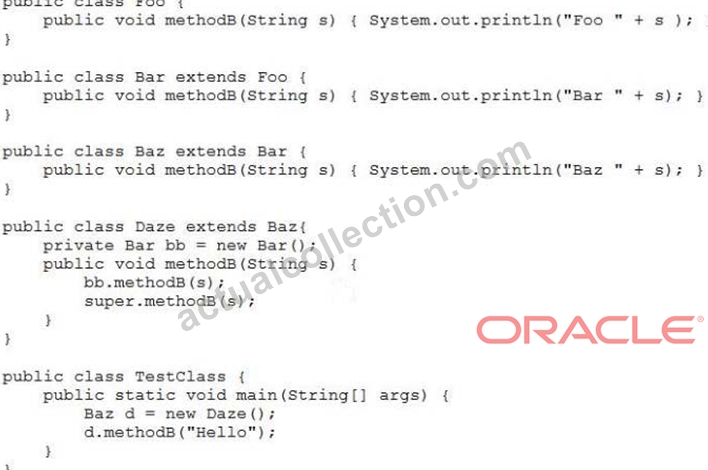
What is the result?
Bar Hello
- A.
- B. A compilation error occurs in the Dazeclass.
- C. Baz Hello
Baz Hello - D. Foo Hello
Bar Hello
Answer: A
NEW QUESTION # 58
Given the code fragments:
4. void doStuff() throws ArithmeticException, NumberFormatException,
Exception {
5. if (Math.random() >-1 throw new Exception ("Try again");
6. }
and
24. try {
25. doStuff ( ):
26. } catch (ArithmeticException | NumberFormatException | Exception e)
{
27. System.out.println (e.getMessage()); }
28. catch (Exception e) {
29. System.out.println (e.getMessage()); }
30. }
Which modification enables the code to print Try again?
- A. Comment the lines 28, 29 and 30.
- B. Replace line 26 with:
} catch (ArithmeticException | NumberFormatException e) { - C. Replace line 26 with:
} catch (Exception | ArithmeticException | NumberFormatException e) { - D. Replace line 27 with:
throw e;
Answer: B
NEW QUESTION # 59
Given the code fragment: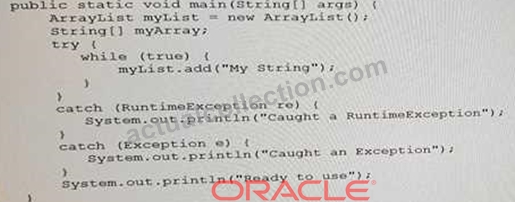
What is the result?
- A. Execution terminates in the first catch statements, and Caught a RuntimeException is printed to the console.
- B. Execution terminates in the second catch statement, and Caught an Exception is printed to the console.
- C. Execution completes normally, and Ready to use is printed to the console.
- D. The code fails to compile because a throws keyword is required.
- E. A runtime error is thrown in the thread "main"
Answer: E
NEW QUESTION # 60
Given:
interface Doable {
public void doSomething (String s);
}
Which two class definitions compile? (Choose two.)
public abstract class Task implements Doable {
- A. public void doSomething(Integer i) { }
public String doThis(Integer j) { }
}
public class Do implements Doable { - B. public void doSomething(Integer i) { }
}
public class Action implements Doable { - C. public void doSomething(Integer i) { }
public void doSomething(String s) { }
public void doThat (String s) { }
} - D. public void doSomethingElse(String s) { }
}
public abstract class Work implements Doable { - E. public abstract void doSomething(String s) { }
public void doYourThing(Boolean b) { }
}
public class Job implements Doable {
Answer: C,D
Explanation:
Explanation/Reference:
NEW QUESTION # 61
Given the Greetings.propertiesfile, containing:
and given: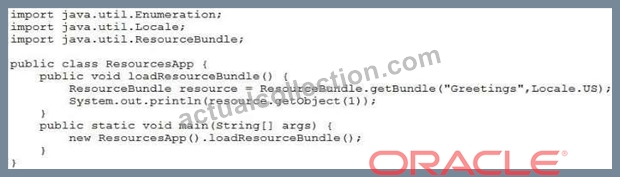
What is the result?
- A. Hello, everyone!
- B. HELLO_MSG
- C. Goodbye everyone!
- D. Compilation fails.
- E. GOODBY_MSG
Answer: D
NEW QUESTION # 62
Given:
class Student {
String course, name, city;
public Student (String name, String course, String city) {
this.course = course; this.name = name; this.city = city;
}
public String toString() {
return course + ":" + name + ":" + city;
}
public String getCourse() {return course;}
public String getName() {return name;}
public String getCity() {return city;}
and the code fragment:
List<Student> stds = Arrays.asList(
new Student ("Jessy", "Java ME", "Chicago"),
new Student ("Helen", "Java EE", "Houston"),
new Student ("Mark", "Java ME", "Chicago"));
stds.stream()
.collect(Collectors.groupingBy(Student::getCourse))
.forEach(src, res) -> System.out.println(scr));
What is the result?
- A. Java EEJava ME
- B. [Java EE: Helen:Houston][Java ME: Jessy:Chicago, Java ME: Mark:Chicago]
- C. A compilation error occurs.
- D. [Java ME: Jessy:Chicago, Java ME: Mark:Chicago][Java EE: Helen:Houston]
Answer: A
NEW QUESTION # 63
Given the code fragment: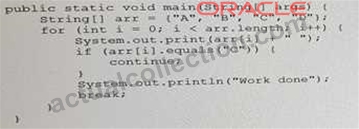
What is the result?
- A. Compilation fails.
- B. A B C Work done
- C. A Work done
- D. A B C D Work done
Answer: C
NEW QUESTION # 64
Given the code fragments:
class Caller implements Callable<String> {
String str;
public Caller (String s) {this.str=s;}
public String call()throws Exception { return str.concat ("Caller");}
}
class Runner implements Runnable {
String str;
public Runner (String s) {this.str=s;}
public void run () { System.out.println (str.concat ("Runner"));}
}
and
public static void main (String[] args) InterruptedException, ExecutionException {
ExecutorService es = Executors.newFixedThreadPool(2);
Future f1 = es.submit (new Caller ("Call"));
Future f2 = es.submit (new Runner ("Run"));
String str1 = (String) f1.get();
String str2 = (String) f2.get();//line n1
System.out.println(str1+ ":" + str2);
}
What is the result?
- A. An Execution is thrown at run time.
- B. A compilation error occurs at line n1.
- C. The program prints:
Run Runner
Call Caller : null
And the program does not terminate. - D. The program terminates after printing:
Run Runner
Call Caller : Run
Answer: C
NEW QUESTION # 65
Given the code fragment:
Which modification enables the code to print Price 5 New Price 4?
- A. Replace line n2 with .mapToInt (n -> n - 1);
- B. Replace line n3 with .forEach (n -> System.out.println ("New Price" + n));
- C. Replace line n1 with .forEach (e -> System.out.print ("Price" + e))
- D. Replace line n2 with .map (n -> System.out.println ("New Price" + n -1)) and remove line n3
Answer: D
NEW QUESTION # 66
Given the code fragments :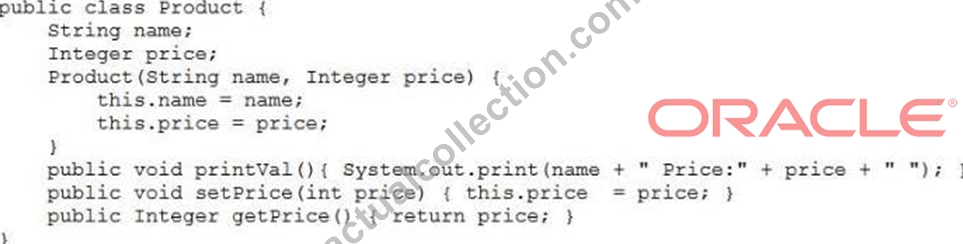
and
What is the result?
TV Price :110 Refrigerator Price :2100
- A. The program prints nothing.
- B. A compilation error occurs.
TV Price :1000 Refrigerator Price :2000 - C.
- D.
Answer: C
NEW QUESTION # 67
Which statement is true about java.time.Duration?
- A. It tracks time zones.
- B. It defines date-based values.
- C. It defines time-based values.
- D. It preserves daylight saving time.
Answer: C
Explanation:
Explanation/Reference: http://tutorials.jenkov.com/java-date-time/duration.html#accessing-the-time-of-a-duration
NEW QUESTION # 68
Given the code fragment:
Path p1 = Paths.get("/Pics/MyPic.jpeg");
System.out.println (p1.getNameCount() +
" :" + p1.getName(1) +
" :" + p1.getFileName());
Assume that the Picsdirectory does NOT exist.
What is the result?
- A. 2:MyPic.jpeg: MyPic.jpeg
- B. 2:Pics: MyPic.jpeg
- C. An exception is thrown at run time.
- D. 1:Pics:/Pics/ MyPic.jpeg
Answer: D
NEW QUESTION # 69
Given the code fragments:
class ThreadRunner implements Runnable {
public void run () { System.out.print ("Runnable") ; }
}
class ThreadCaller implements Callable {
Public String call () throws Exception {return "Callable"; )
}
and
ExecutorService es = Executors.newCachedThreadPool ();
Runnable r1 = new ThreadRunner ();
Callable c1 = new ThreadCaller ();
// line n1
es.shutdown();
Which code fragment can be inserted at line n1 to start r1 and c1 threads?
- A. es.submit(r1);Future<String> f1 = es.submit (c1);
- B. Future<String> f1 = (Future<String>) es.submit (r1);es.execute (c1);
- C. Future<String> f1 = (Future<String>) es.execute(r1);Future<String> f2 = (Future<String>) es.execute(c1);
- D. es.execute (r1);Future<String> f1 = es.execute (c1) ;
Answer: A
NEW QUESTION # 70
Given the records from the Employeetable:
and given the code fragment:
try {
Connection conn = DriverManager.getConnection (URL, userName, passWord); Statement st = conn.createStatement(ResultSet.TYPE_SCROLL_INSENSITIVE,
ResultSet.CONCUR_UPDATABLE);
st.execute("SELECT*FROM Employee");
ResultSet rs = st.getResultSet();
while (rs.next()) {
if (rs.getInt(1) ==112) {
rs.updateString(2, "Jack");
}
}
rs.absolute(2);
System.out.println(rs.getInt(1) + " " + rs.getString(2));
} catch (SQLException ex) {
System.out.println("Exception is raised");
}
Assume that:
The required database driver is configured in the classpath.
The appropriate database accessible with the URL, userName, and passWordexists.
What is the result?
- A. The Employee table is updated with the row:
1 12 Jack
and the program prints:
1 12 Jack - B. The program prints Exception is raised.
- C. The Employee table is updated with the row:
1 12 Jack
and the program prints:
1 12 Jerry - D. The Employee table is not updated and the program prints:
1 12 Jerry
Answer: B
NEW QUESTION # 71
Given the code fragments:
class Caller implements Callable<String> {
String str;
public Caller (String s) {this.str=s;}
public String call()throws Exception { return str.concat ("Caller");}
}
class Runner implements Runnable {
String str;
public Runner (String s) {this.str=s;}
public void run () { System.out.println (str.concat ("Runner"));}
}
and
public static void main (String[] args) InterruptedException, ExecutionException { ExecutorService es = Executors.newFixedThreadPool(2); Future f1 = es.submit (new Caller ("Call")); Future f2 = es.submit (new Runner ("Run")); String str1 = (String) f1.get(); String str2 = (String) f2.get();//line n1 System.out.println(str1+ ":" + str2);
}
What is the result?
- A. An Execution is thrown at run time.
- B. A compilation error occurs at line n1.
- C. The program prints:
Run Runner
Call Caller : null
And the program does not terminate. - D. The program terminates after printing:
Run Runner
Call Caller : Run
Answer: C
NEW QUESTION # 72
Which statement is true about Java byte code?
- A. It can run on any platform that has a Java compiler.
- B. It can run on any platform that has the Java Runtime Environment.
- C. It can run on any platform only if it was compiled for that platform.
- D. It can run on any platform.
- E. It can run on any platform only if that platform has both the Java Runtime Environment and a Java compiler.
Answer: B
Explanation:
We are talking about byte code so the Java program has been compiled.
The question ask for what we need to run the byte code.
https://www.java.com/en/download/faq/whatis_java.xml
http://www.researchgate.net/post/Run_Java_Application_Without_Installing_Java_Runtime
NEW QUESTION # 73
Given:
class Book {
int id;
String name;
public Book (int id, String name) {
this.id = id;
this.name = name;
}
public boolean equals (Object obj) { //line n1
boolean output = false;
Book b = (Book) obj;
if (this.name.equals(b name))}
output = true;
}
return output;
}
}
and the code fragment:
Book b1 = new Book (101, "Java Programing");
Book b2 = new Book (102, "Java Programing");
System.out.println (b1.equals(b2)); //line n2
Which statement is true?
- A. The program prints false.
- B. A compilation error occurs. To ensure successful compilation, replace line n1with:
boolean equals (Book obj) { - C. A compilation error occurs. To ensure successful compilation, replace line n2with:
System.out.println (b1.equals((Object) b2)); - D. The program prints true.
Answer: B
NEW QUESTION # 74
......
Authentic 1z1-809 Dumps With 100% Passing Rate Practice Tests Dumps: https://quizguide.actualcollection.com/1z1-809-exam-questions.html