

[Apr 13, 2026] New NSE5_SSE_AD-7.6 Exam Dumps with High Passing Rate
Get NSE5_SSE_AD-7.6 Braindumps & NSE5_SSE_AD-7.6 Real Exam Questions
Fortinet NSE5_SSE_AD-7.6 Exam Syllabus Topics:
| Topic | Details |
|---|---|
| Topic 1 |
|
| Topic 2 |
|
| Topic 3 |
|
| Topic 4 |
|
| Topic 5 |
|
NEW QUESTION # 28
Refer to the exhibits.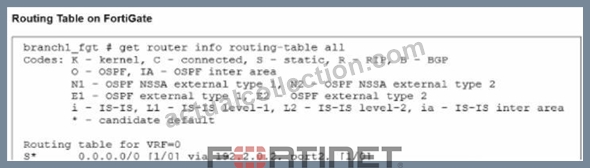
The administrator increases the member priority on port2 to 20. Upon configuration changes and the receipt of new packets, which two actions does FortiGate perform on existing sessions established over port2?
(Choose two.)
- A. FortiGate continues routing all existing sessions over port2.
- B. FortiGate flags the SNAT session as dirty only if the administrator has assigned an IP pool to the firewall policies with NAT.
- C. FortiGate flags the sessions as dirty.
- D. FortiGate updates the gateway information of the sessions with SNAT so that they use port1 instead of port2.
- E. FortiGate routes only new sessions over port1.
Answer: C,D
NEW QUESTION # 29
How is the Geofencing feature used in FortiSASE? (Choose one answer)
- A. To monitor user behavior on websites and block non-work-related content from specific countries
- B. To restrict access to applications based on the time of day in specific countries.
- C. To allow or block remote user connections to FortiSASE POPs from specific countries.
- D. To encrypt data at rest on mobile devices in specific countries.
Answer: C
Explanation:
FortiSASE geofencing controls connectivity by permitting or denying remote user and edge device access to its Points of Presence (PoPs) based on the originating country, enhancing security through location-based restrictions.
Administrators configure country lists in the FortiSASE portal to enforce compliance or mitigate regional threats, applying uniformly to VPN tunnels or agent connections without affecting post- connection traffic.
NEW QUESTION # 30
Refer to the exhibit. An administrator is troubleshooting SD-WAN on FortiGate. A device behind branch1_fgt generates traffic to the 10.0.0.0/8 network.
The administrator expects the traffic to match SD-WAN rule ID 1 and be routed over HUB1- VPN1.
However, the traffic is routed over HUB1-VPN3.
Based on the output shown in the exhibit, which two reasons, individually or together, could explain the observed behavior? (Choose two.)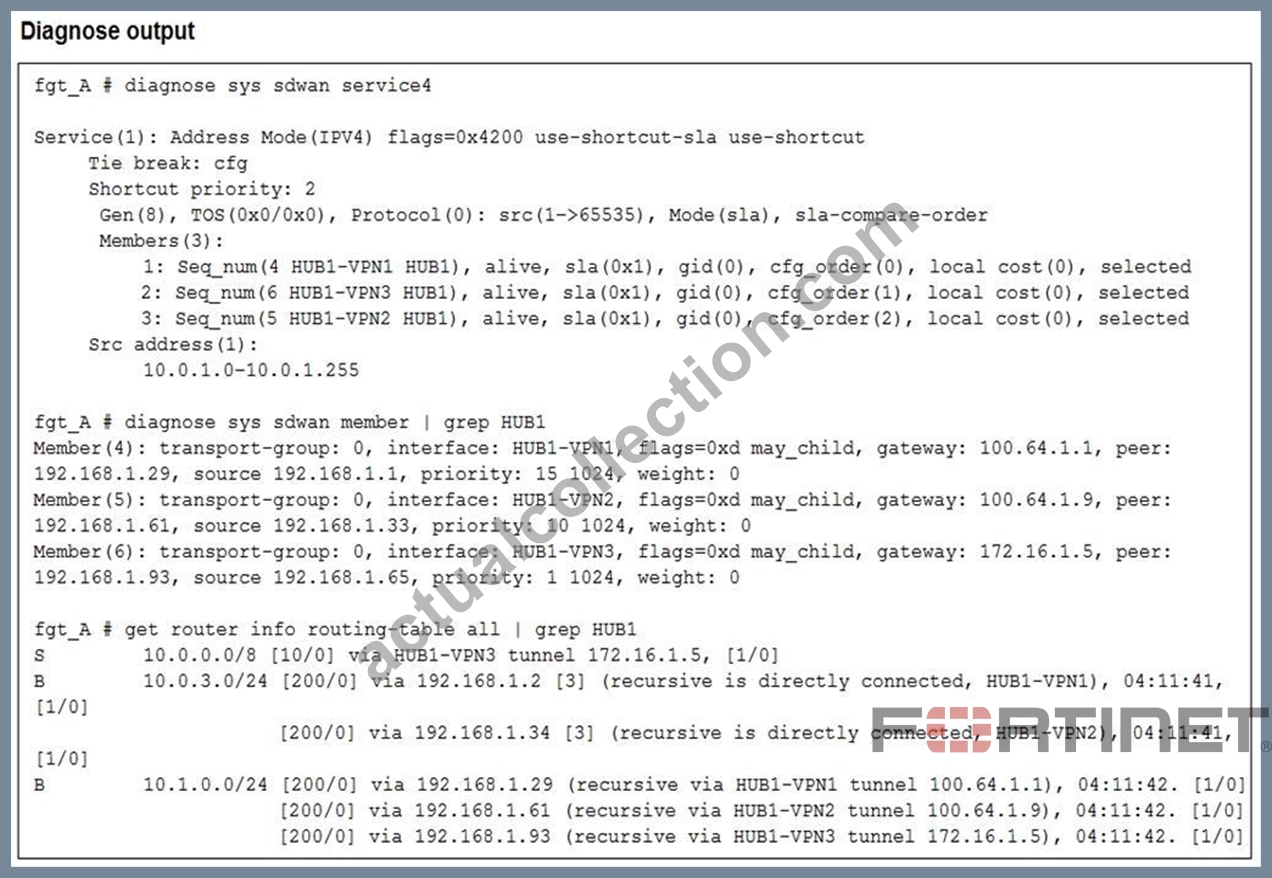
- A. The traffic matches a regular policy route configured with HUB1-VPN3 as the outgoing device.
- B. HUB1-VPN3 has a lower route priority value (higher priority) than HUB1-VPN1.
- C. HUB1-VPN3 has a higher member configuration priority than HUB1-VPN1.
- D. HUB1-VPN1 does not have a valid route to the destination.
Answer: A,D
Explanation: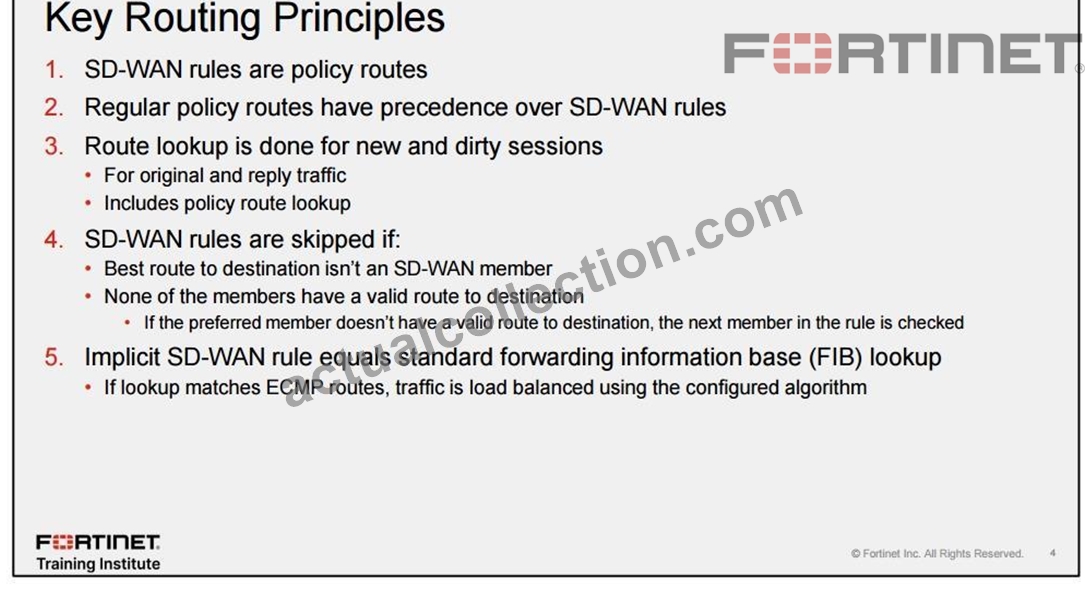
NEW QUESTION # 31
Which three reports are valid report types in FortiSASE? (Choose three.)
- A. Web Usage Summary Report
- B. Shadow IT Report
- C. Cyber Threat Assessment
- D. Vulnerability Assessment Report
- E. Endpoint Compliance Deviation Report
Answer: A,B,D
NEW QUESTION # 32
Refer to the exhibit, which shows the SD-WAN rule status and configuration.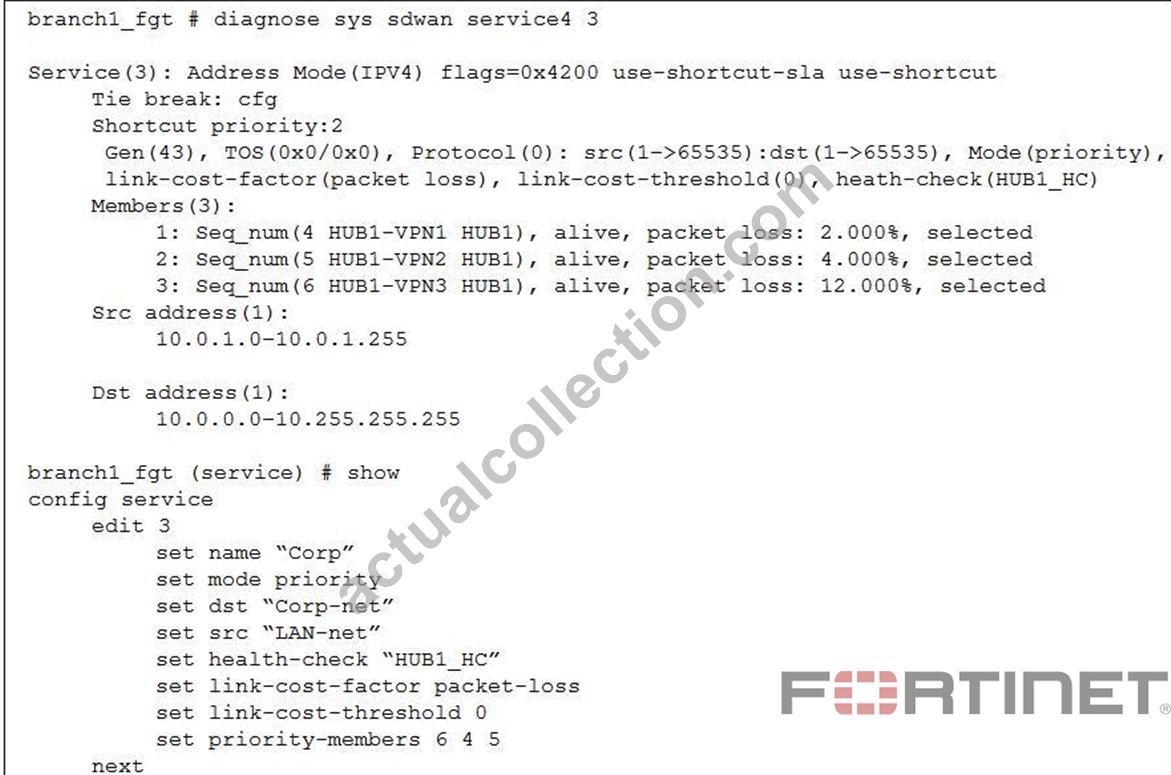
Based on the exhibit, which change in the measured packet loss will make HUB1-VPN3 the new preferred member? (Choose one answer)
- A. When HUB1-VPN1 has 4% packet loss
- B. When HUB1-VPN1 has 12% packet loss
- C. When HUB1-VPN3 has 4% packet loss
- D. When all three members have the same packet loss
Answer: D
Explanation:
According to theSD-WAN 7.6 Core Administratorstudy guide and theFortiOS 7.6 Administration Guide, the selection process for theBest Quality (priority)strategy depends on two primary factors: the measured link quality metric and the configured member priority order.
Based on the provided exhibit (image_b40dfc.png), we can determine the following:
* Strategy and Metric: The rule is in Mode(priority) (Best Quality) using link-cost-factor(packet loss).
* Strict Comparison: The link-cost-threshold is set to0. This means there is no "advantage" given to the current preferred link; the FortiGate performs a strict comparison where the link with the objectively best metric is chosen.
* Tie-Breaker Logic: When multiple links have thesamepacket loss, the FortiGate uses theMember Priority Orderdefined in the rule (set priority-members 6 4 5) as the tie-breaker.
* Member 6 (HUB1-VPN3)is the highest priority.
* Member 4 (HUB1-VPN1)is the second priority.
* Member 5 (HUB1-VPN2)is the lowest priority.
* Current State: HUB1-VPN1 is currently selected because its packet loss (2.000%) is lower than HUB1-VPN2 (4.000%) and HUB1-VPN3 (12.000%). Even though HUB1-VPN3 has a higher configuration priority, its significantly higher packet loss prevents it from being chosen.
Evaluation of Options:
* Option A (Verified): If all three members have thesame packet loss(e.g., they all show 2%), the quality metrics are equal. The SD-WAN engine then refers to the priority-members list. Since HUB1- VPN3 (Seq 6) is the first member in that list, it will immediately become the new preferred member.
* Option B: If HUB1-VPN1 reaches 4%, it matches HUB1-VPN2 (4%). HUB1-VPN3 remains at 12%.
The system will choose between VPN1 and VPN2. Since VPN1 (Seq 4) is higher in the priority list than VPN2 (Seq 5), HUB1-VPN1 stays preferred.
* Option C: If HUB1-VPN1 reaches 12%, it matches HUB1-VPN3. However, HUB1-VPN2 is still better at4.000%. Therefore, HUB1-VPN2 would become the new preferred member, not HUB1-VPN3.
* Option D: If HUB1-VPN3 drops to 4%, it matches HUB1-VPN2. However, HUB1-VPN1 is still the best link at2.000%, so it remains selected.
NEW QUESTION # 33
Which FortiSASE feature monitors SaaS application performance and connectivity to points of presence (POPs)?
- A. Operations widgets
- B. Event logs
- C. Digital experience monitoring
- D. FortiView dashboards
Answer: C
Explanation:
The Digital Experience Monitor (DEM) feature on FortiSASE provides end-to-end network visibility by monitoring the performance and health of connections between FortiSASE security Points of Presence (PoPs) and specific SaaS applications, allowing IT teams to troubleshoot connectivity issues and ensure smooth user experience.
NEW QUESTION # 34
Refer to the exhibit. Which conclusion can you draw from the exhibit?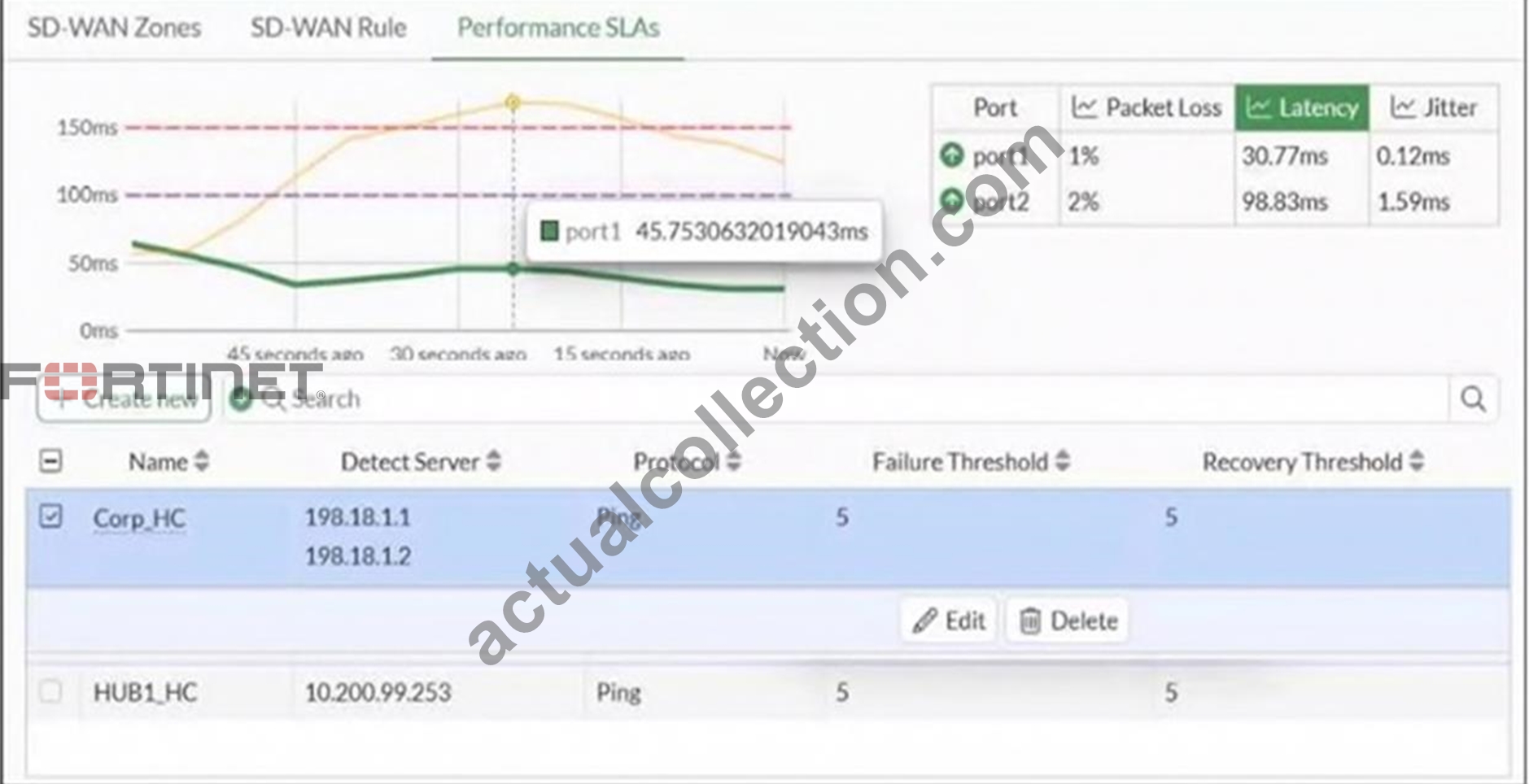
- A. The administrator configured the Corp_HC performance service-level agreement (SLA) with SLA targets for the three criteria: packet loss, latency, and jitter.
- B. The administrator configured the packet loss threshold for Corp_HC and HUB1_HC to 5%.
- C. Over the past 60 seconds, the member port2 latency was temporarily above the latency criteria defined for HUB1_HC.
- D. Over the past 60 seconds, the member port1 was monitored healthy for both latency criteria of the Corp_HC definition.
Answer: D
Explanation:
The graph shows the latency history for the Corp_HC SLA, and port1's latency remained below the defined threshold during the past 60 seconds. This indicates that port1 continuously met the Corp_HC latency SLA and was therefore monitored as healthy.
NEW QUESTION # 35
You want FortiGate to use SD-WAN rules to steer ping local-out traffic. Which two constraints should you consider? (Choose two.)
- A. You can steer local-out traffic only with SD-WAN rules that use the manual strategy.
- B. By default, FortiGate uses SD-WAN rules only for local-out traffic that corresponds to ping and traceroute.
- C. By default, FortiGate uses SD-WAN rules only for local-out traffic that corresponds to ping and traceroute.
- D. You must configure each local-out feature individually to use SD-WAN.
Answer: C,D
Explanation:
In theSD-WAN 7.6 Core Administratorcurriculum, steering "local-out" traffic (traffic generated by the FortiGate itself, such as DNS queries, FortiGuard updates, or diagnostic pings) requires specific configuration because this traffic follows a different path than "forward" traffic.
* Individual Configuration (Option A): By default, local-out traffic bypasses the SD-WAN engine and uses the standard system routing table (RIB/FIB). To use SD-WAN rules for specific features like DNS or RADIUS, you must individually enable the sdwan interface-select-method within that feature's configuration (e.g., config system dns or config user radius).
* Default Steerable Traffic (Option B): In FortiOS 7.6, while most local-out traffic is excluded from SD-WAN by default, the system is designed so that when SD-WAN is active, it primarily considers SD- WAN rules for specific diagnostic local-out traffic-specificallypingandtraceroute-to allow administrators to verify path quality using the same logic as user traffic.
Why other options are incorrect:
* Option C: Local-out traffic can be steered using any SD-WAN strategy (Manual, Best Quality, etc.), provided the interface-selection-method is set to sdwan.
NEW QUESTION # 36
An SD-WAN member is no longer used to steer SD-WAN traffic. You want to update the SD-WAN configuration and delete the unused member.
Which action should you take first? (Choose one answer)
- A. Remove the member from the performance service-level agreement (SLA) definitions.
- B. Disable the interface.
- C. Delete static route definitions for that interface.
- D. Move the SD-WAN member to the virtual-wan-link zone.
Answer: A
Explanation:
According to theSD-WAN 7.6 Core Administratorstudy guide and theFortinet Document Library, FortiOS maintains strict referential integrity for SD-WAN objects. An SD-WAN member interface cannot be deleted or removed from the configuration if it is still being "used" or referenced by other features.
* Reference Locking: In the FortiOS GUI, the "Delete" button for an SD-WAN member is typically grayed out or an error message appears if the interface is part of an active service or monitoring tool.
* Performance SLA Dependency: Performance SLAs (health checks) monitor specific member interfaces. If an interface is a participant in an SLA, it is considered "active" by the system. Therefore, a critical first step in the decommissioning process is toremove the member from all Performance SLA definitions. Once the health check is no longer polling that interface, one major reference lock is released.
* Other Dependencies: While firewall policies and SD-WAN rules (service rules) also create references, the question specifies the member is "no longer used to steer traffic," implying it may have already been removed from steering rules. However, Performance SLAs often remain active in the background, making their removal the essential next step to permit the deletion of the member itself.
Why other options are incorrect:
* Option A: Moving a member between zones doesn't help you delete it; it just changes its logical grouping. It still remains an active SD-WAN member.
* Option B: Disabling the physical interface does not remove the configuration references within the SD- WAN engine. The FortiGate will simply report the member as "Down," but it will still exist in the configuration as a member.
* Option D: In modern SD-WAN deployments, static routes usually point to theSD-WAN Zone(like virtual-wan-link) rather than individual physical interfaces. Therefore, you don't typically need to delete the static route to remove a single member from the zone.
NEW QUESTION # 37
Which statement is true about scheduling a FortiClient upgrade using an endpoint upgrade rule?
- A. When scheduled, the installation always starts immediately if the endpoint is online.
- B. Scheduled upgrades automatically reboot macOS endpoints after installation.
- C. If the scheduled time is already past in the local time zone of the endpoint, installation starts the next day at that time.
- D. An endpoint upgrade rule can be assigned to a user group.
Answer: C
Explanation:
A scheduled FortiClient upgrade is executed according to the endpoint's local time. If the scheduled time has already passed in that time zone, the upgrade is deferred until the same time on the following day.
NEW QUESTION # 38
Which two statements about configuring a steering bypass destination in FortiSASE are correct?
(Choose two.)
- A. Apply condition allows split tunneling destinations to be applied to On-net, Off-net, or both types of endpoints.
- B. Subnet is the only destination type that supports the Apply condition.
- C. You can select from four destination types: Infrastructure, FQDN, Local Application, or Subnet.
- D. Apply condition can be set only to On-net or Off-net, but not both.
Answer: A,C
Explanation:
Steering bypass destinations support four destination types: Infrastructure, FQDN, Local Application, and Subnet.
The Apply condition determines whether the bypass applies to On-net, Off-net, or both endpoint states.
NEW QUESTION # 39
Which three reports are valid report types in FortiSASE? (Choose three.)
- A. Web Usage Summary Report
- B. Shadow IT Report
- C. Cyber Threat Assessment
- D. Vulnerability Assessment Report
- E. Endpoint Compliance Deviation Report
Answer: A,B,D
Explanation:
Shadow IT Report: Leveraging the built-in CASB (Cloud Access Security Broker) capabilities, this report identifies "unsanctioned" or "risky" SaaS applications being used by employees. It helps organizations discover hidden security risks by cataloging cloud applications that have not been explicitly approved by the IT department.
Vulnerability Assessment Report: Since FortiSASE integrates with FortiClient and an embedded EMS, it can aggregate vulnerability scan data from managed endpoints. This report lists software vulnerabilities found on user devices (OS-level and application-level), providing a "Security Rating" or posture assessment that is critical for Zero Trust Network Access (ZTNA) enforcement.
Web Usage Summary Report: This report provides a high-level overview of web activity across the SASE deployment. It categorizes traffic by website categories (e.g., Social Media, Streaming, Malicious Sites), top users by bandwidth, and blocked requests, helping IT teams understand how internet resources are being consumed by remote workers.
NEW QUESTION # 40
You have configured the performance SLA with the probe mode as Prefer Passive.
What are two observable impacts of this configuration? (Choose two.)
- A. FortiGate passively monitors the member if TCP traffic is passing through the member.
- B. FortiGate can offload the traffic that is subject to passive monitoring to hardware.
- C. After FortiGate switches to active mode, the SLA performance rule falls back to passive monitoring after 3 minutes.
- D. FortiGate passively monitors the member if ICMP traffic is passing through the member.
- E. During passive monitoring, the SLA performance rule cannot detect dead members.
Answer: A,E
Explanation:
When "Prefer Passive" is set, FortiGate attempts to passively monitor the health of SD-WAN members using real application traffic like TCP sessions, collecting statistics such as latency, jitter, and packet loss from actual observed flows.
Passive monitoring does not generate probe packets; it relies entirely on existing traffic. If there is no matching traffic, health check data is unavailable, meaning dead members may go undetected when only passive monitoring is active.
NEW QUESTION # 41
What is the purpose of the priority/failover connection feature in FortiSASE Geofencing for managing VPN connections?
- A. It forces all remote users to connect only to the nearest security POP regardless of location.
- B. It automatically balances VPN traffic across all available security POPs without prioritizing on- premises devices.
- C. It restricts VPN access to users based on their geolocation without allowing failover options.
- D. It allows administrators to define rules to prioritize on-premises FortiGate connections for users in specific countries, with failover to a security POP if the FortiGate device is unavailable.
Answer: D
Explanation:
Priority/failover in FortiSASE geofencing lets administrators prefer an on-premises FortiGate for users in specified countries and fail over to a FortiSASE security POP only if the on-premises device is unreachable.
NEW QUESTION # 42
Which two statements about configuring a steering bypass destination in FortiSASE are correct? (Choose two.)
- A. Apply condition allows split tunneling destinations to ae applied to On-net. off-net. or both types of endpoints
- B. You can select from four destination types: Infrastructure, FQDN, Local Application, or Subnet
- C. Subnet is the only destination type that supports the Apply condition
- D. Apply condition can be set only to On-net or Off-net. but not both
Answer: A,B
Explanation:
According to theFortiSASE 7.6 Feature Administration Guide, steering bypass destinations (also known as split tunneling) allow administrators to optimize bandwidth by redirecting specific trusted traffic away from the SASE tunnel to the endpoint's local physical interface.
* Destination Types (Option C): When creating a bypass destination, administrators can select from four distinct types:Infrastructure(pre-defined apps like Zoom/O365),FQDN(specific domains),Local Application(identifying processes on the laptop), orSubnet(specific IP ranges).
* Apply Condition (Option B): The "Apply" condition is a flexible setting that allows the administrator to choose when the bypass is active. It can be applied to endpoints that areOn-net(inside the office),Off- net(remote), orBoth. This ensures that if a user is in the office, they don't use the SASE tunnel for local resources, but if they are home, they might still bypass high-bandwidth sites like YouTube to preserve tunnel capacity.
Why other options are incorrect:
* Option A: Subnet is one of four types and is not the only type supporting these conditions.
* Option D: The system explicitly supports "Both" to ensure consistency across network transitions.
NEW QUESTION # 43
Which three factors about SLA targets and SD-WAN rules should you consider when configuring SD-WAN rules? (Choose three.)
- A. SLA targets are used only by SD-WAN rules that are configured with a Lowest Cost (SLA) strategy.
- B. SD-WAN rules can use SLA targets to check whether the preferred members meet the SLA requirements.
- C. Member metrics are measured only if a rule uses the SLA target.
- D. When configuring an SD-WAN rule, you can select multiple SLA targets if they are from the same performance SLA.
- E. When configuring an SD-WAN rule, you can select multiple SLA targets from different performance SLAs.
Answer: A,B,D
Explanation:
The use of SLA targets is specific to certain SD-WAN strategies. The "Lowest Cost (SLA)" and
"Maximize Bandwidth (SLA)" strategies are explicitly designed to use the configured SLA targets to make routing decisions. The "Best Quality" strategy uses performance metrics but does not necessarily require or reference SLA targets in the same way, while "Manual" does not use metrics at all for path selection.
This is a core function of SD-WAN rules with SLA targets. The purpose of configuring an SLA target with specific thresholds for latency, jitter, and packet loss is to define what is considered
"acceptable" performance for an application. SD-WAN rules then use these targets to check if the members (interfaces) meet these requirements before a flow is steered over them, ensuring that a preferred path still offers a good user experience.
FortiGate allows for a single SD-WAN rule to reference multiple, different performance SLAs. This is crucial for complex deployments where a single SD-WAN rule needs to handle traffic for multiple applications that have distinct performance requirements. For example, a single rule might direct VoIP traffic based on one performance SLA with strict latency/jitter targets, while simultaneously handling general web traffic using another performance SLA with more lenient requirements.
NEW QUESTION # 44
A FortiGate device is in production. To optimize WAN link use and improve redundancy, you enable and configure SD-WAN.
What must you do as part of this configuration update process? (Choose one answer)
- A. Purchase and install the SD-WAN license, and reboot the FortiGate device.
- B. Replace references to interfaces used as SD-WAN members in the firewall policies.
- C. Disable the interface that you want to use as an SD-WAN member.
- D. Replace references to interfaces used as SD-WAN members in the routing configuration.
Answer: B
Explanation:
According to theSD-WAN 7.6 Core Administratorstudy guide and theFortiOS 7.6 Administration Guide, when you are migrating a production FortiGate to use SD-WAN, the most critical step involves reconfiguring how traffic is permitted and routed.
* Reference Removal Requirement: Before an interface (such as wan1 or wan2) can be added as anSD- WAN member, it must be "unreferenced" in most parts of the FortiGate configuration. Specifically, if an interface is currently being used in an activeFirewall Policy, the system will prevent you from adding it to the SD-WAN bundle.
* Firewall Policy Migration (Option A): In a production environment, you mustreplace the references to the physical interfacesin your firewall policies with the newSD-WAN virtual interface(or an SD- WAN Zone). For example, if your previous policy allowed traffic from internal to wan1, you must update that policy so theOutgoing Interfaceis now SD-WAN. This allows the SD-WAN engine to take over the traffic and apply its steering rules.
* Modern Tools: While this used to be a purely manual process, FortiOS 7.x includes anInterface Migration Wizard(found underNetwork > Interfaces). This tool automates the "search and replace" function, moving all existing policy and routing references from the physical port to the SD-WAN object to ensure minimal downtime.
Why other options are incorrect:
* Option B: While you do need to update your routing (e.g., creating a static route for 0.0.0.0/0 pointing to the SD-WAN interface), the curriculum specifically emphasizes the replacement of references in firewall policiesas the primary administrative hurdle, as policies are often more numerous and complex than the single static route required for SD-WAN.
* Option C: You donotneed to disable the interface. It must be up and configured, just removed from other configuration references so it can be "absorbed" into the SD-WAN bundle.
* Option D: SD-WAN is abase featureof FortiOS and doesnot require a separate licenseor a reboot to enable.
NEW QUESTION # 45
Which two delivery methods are used for installing FortiClient on a user's laptop? (Choose two.)
- A. Use zero-touch installation through a third-party application store.
- B. Download the installer directly from the FortiSASE portal.
- C. Configure automatic installation through an API to the user's laptop.
- D. Send an invitation email to selected users containing links to FortiClient installers.
Answer: B,D
NEW QUESTION # 46
Refer to the exhibit. The exhibit shows output of the command diagnose sys sdwan service collected on a FortiGate device.
The administrator wants to know through which interface FortiGate will steer traffic from local users on subnet 10.0.1.0/255.255.255.192 and with a destination of the social media application Facebook.
Based on the exhibits, which two statements are correct? (Choose two.)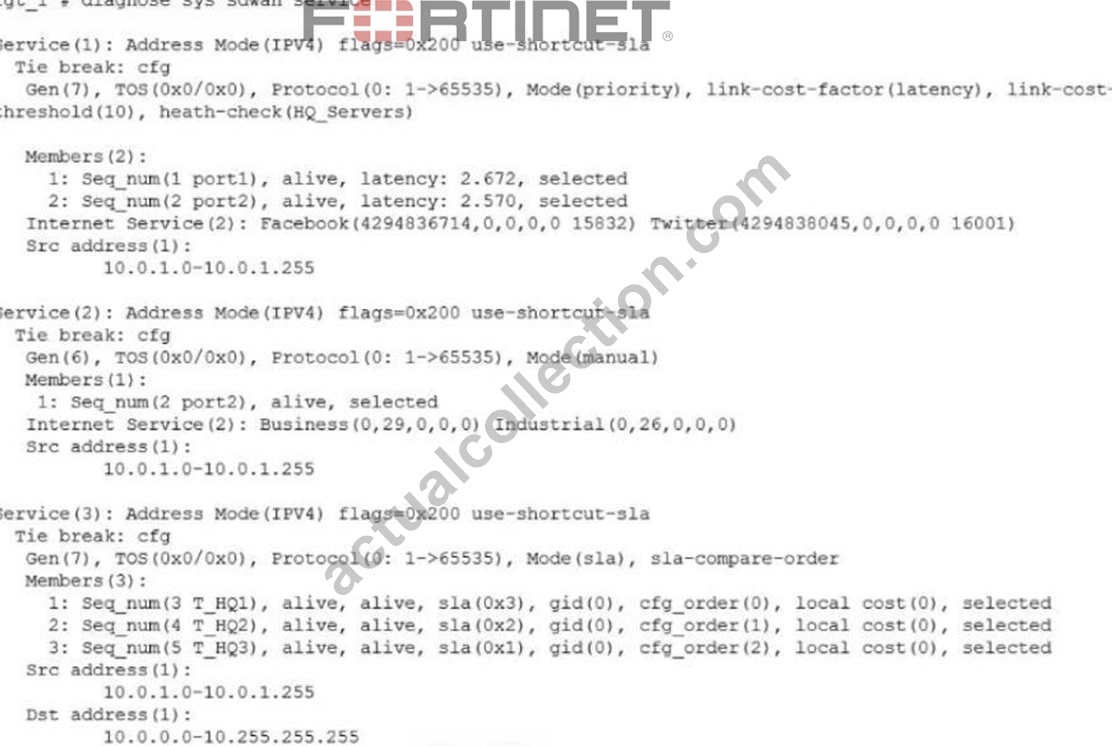
- A. FortiGate steers traffic for social media applications according to the service rule 2 and steers traffic through port2.
- B. When FortiGate cannot recognize the application of the flow, it load balances the traffic through the tunnels HQ_T1, HQ_T2, HQ_T3.
- C. When FortiGate cannot recognize the application of the flow, it steers the traffic through the preferred member of rule 3, HQ_T1.
- D. There is no service defined for the Facebook application, so FortiGate applies service rule 3 and directs the traffic to headquarters.
Answer: A,B
Explanation:
"If a flow is identified as belonging to a defined application category (such as social media), FortiGate will match it to the corresponding service rule (rule 2) and route it through the specified interface, such as port2. However, if the application is not recognized during the session setup, the system defaults to load balancing the traffic using the available tunnels according to the policy for unclassified traffic, ensuring continuous connectivity while waiting for application classification." This guarantees both performance and resilience.
NEW QUESTION # 47
......
NSE5_SSE_AD-7.6 Dumps To Pass Fortinet Exam in 24 Hours - ActualCollection: https://quizguide.actualcollection.com/NSE5_SSE_AD-7.6-exam-questions.html