

[Apr-2026] Study resources for the Valid NCP-CI-Azure Braindumps!
Updated NCP-CI-Azure Tests Engine pdf - All Free Dumps Guaranteed!
Nutanix NCP-CI-Azure Exam Syllabus Topics:
| Topic | Details |
|---|---|
| Topic 1 |
|
| Topic 2 |
|
| Topic 3 |
|
| Topic 4 |
|
NEW QUESTION # 14
Which entity should be contacted for cloud hardware support (EC2 instances, VPC, etc) related to NC2?
- A. Partner
- B. Public Cloud Vendor
- C. Internal IT Operations team
- D. Nutanix
Answer: B
Explanation:
Cloud Hardware Support: For issues related to cloud hardware, such as EC2 instances or VPC configurations, the responsible entity is typically the public cloud vendor.
Nutanix Responsibility: Nutanix manages the software layer and integration aspects of the NC2 service, but the underlying hardware support is managed by the cloud provider (e.g., AWS, Azure).
Support Process:
Public Cloud Vendor: Contact the public cloud vendor for issues directly related to the hardware, as they own and manage the physical infrastructure.
Nutanix: For software and configuration issues specific to the NC2 service, contact Nutanix support.
Conclusion: For cloud hardware-related support, the appropriate contact is the public cloud vendor.
Reference:
Nutanix Support Guide
Azure Support Documentation
NEW QUESTION # 15
Exhibit.
An administrator is trying to figure out why the NC2 cluster deployment in Azure failed.
Which issue might be the cause?
- A. The selected bare metal node type is not supported in the deployment region.
- B. The company does not have sufficient NCI/AOS licenses.
- C. DNS servers are not reachable from cluster management VNet.
- D. The administrator has not specified a DNS server during deployment.
Answer: A
Explanation:
* Error Message Analysis:The error message indicates that the node cannot boot successfully and will be replaced with a new node. This points towards an issue related to the specific node type or configuration.
* Bare Metal Node Support:One common cause for such deployment failures is selecting a bare metal node type that is not supported in the chosen deployment region. Azure has specific regions where certain node types are available, and attempting to use an unsupported node type in a region can result in provisioning failures.
References:
* Nutanix KB 9768 for troubleshooting deployment issues: KB 9768
* Azure Region Availability Documentation
* Nutanix NC2 on Azure Deployment Guide
NEW QUESTION # 16
When selecting the NC2 subscription plan from the Nutanix billing portal, which options are available?
- A. Pay-as-you-Go (PayG), Cloud Provider Credits, Bring you own License (BYOL)
- B. Reserved instances, Cloud Provider Credits, Bring your own License (BYOL)
- C. Reserved instances, Bring your own License (BYOL)
- D. Pay-as-you-Go (payG), Bring your own License (BYOL)
Answer: D
Explanation:
When selecting the NC2 subscription plan from the Nutanix billing portal, the available options are:
Pay-as-you-Go (PayG): Allows you to pay for the services as you use them, providing flexibility and avoiding upfront costs.
Bring your own License (BYOL): Enables you to use your existing Nutanix licenses within the cloud environment, offering cost savings if you already have licenses.
These options provide flexibility in how you can manage and pay for your Nutanix cloud clusters. Reference Nutanix Cloud Clusters Pricing and Plans
NEW QUESTION # 17
An administrator deploys a new NC2 cluster in Azure in a new subscription. No VPN or Express Route exists.
Which two actions will allow the administrator access to Prism Central to start the configuration? (Choose two.)
- A. Deploy a Jump Host VM instance in the Prism Central VNet inside a non-delegated subnet.
- B. Deploy a Jump Host VM instance in an external VNet and peer the VNets.
- C. Deploy a Jump Host VM instance and NAT Gateway in an external VNet and peer the VNets.
- D. Deploy a Jump Host VM instance in the Prism Central VNet inside a delegated subnet.
Answer: B,D
Explanation:
* Jump Host VM in External VNet with VNet Peering:
* Deploy Jump Host VM:Deploy a VM in an external VNet that is not within the same network as Prism Central.
* VNet Peering:Establish VNet peering between the external VNet and the Prism Central VNet.
This allows the Jump Host to communicate with Prism Central securely.
* Jump Host VM in Prism Central VNet Inside a Delegated Subnet:
* Deploy Jump Host VM:Deploy the Jump Host VM directly in the Prism Central VNet within a delegated subnet. This places the Jump Host in the same network environment as Prism Central, allowing direct access.
References:
* Azure VNet Peering Documentation
* Nutanix NC2 Networking and Access Configuration Guide
NEW QUESTION # 18
An administrator is deploying an NC2 cluster in Azure and observes on NC2 console that nodes will not progress and continue in a Booting state.
What is the most likely cause for the node not continuing to deploy?
- A. An Azure Support case must first be submitted for allowlisting the Azure subscription.
- B. The subscription has not been validated to be allowlisted by Microsoft.
- C. A private DNS server is being used that is not reachable.
- D. The Azure account does not have an active subscription.
Answer: B
Explanation:
Azure Subscription Validation: When deploying an NC2 cluster, the Azure subscription must be validated and allowlisted by Microsoft. This is a crucial step to ensure that the necessary permissions and configurations are set up for the deployment.
Booting State Issue: If the nodes are stuck in the Booting state, it often indicates that the subscription has not been properly validated and allowlisted. This prevents the deployment from progressing as required resources and permissions are not fully accessible.
Checking Allowlisting Status: Administrators should verify that their subscription has been allowlisted by contacting Azure support or checking the status through the Azure portal.
Resolution: Once the subscription is validated and allowlisted by Microsoft, the deployment should proceed without the nodes getting stuck in the Booting state.
Reference:
Nutanix NC2 on Azure Documentation
Azure Subscription Management
NEW QUESTION # 19
What action is performed in Azure when an instance is reported as being in a terminated state, but NC2 expects it to be in a running state?
- A. NC2 alerts the administrator that a manual replacement is required.
- B. NC2 restarts the AHV host.
- C. NC2 automatically reconnects with the instance.
- D. NC2 condemns the host and triggers replacement of the host.
Answer: D
Explanation:
* Instance Termination Detection:When an instance in Azure is reported as being in a terminated state but NC2 expects it to be running, the system will automatically take corrective actions.
* Host Condemnation and Replacement:NC2 will condemn the host, marking it as unusable, and will then trigger the replacement process to ensure that the cluster maintains its required capacity and performance levels. This automatic handling ensures minimal disruption to the workloads running on the cluster.
References:
* Nutanix NC2 Automated Management Features
* Azure Instance State Documentation
NEW QUESTION # 20
An organization uses a Pay As. You Go subscription plan and wants to pay directly to Nutanix.
What is a valid payment method available to pay directly to Nutanix?
- A. Via Online Payment Platform
- B. Via Physical Check
- C. Via Credit Card
- D. Via Wire Transfer
Answer: D
Explanation:
* Payment Method Options:When using a Pay As You Go subscription plan and opting to pay directly to Nutanix, wire transfer is a valid and secure payment method.
* Direct Payment:Wire transfers allow for the direct transfer of funds from the organization's bank account to Nutanix, ensuring a straightforward and efficient payment process.
References:
* Nutanix Billing and Payment Documentation
* Pay As You Go Subscription Payment Methods Guide
NEW QUESTION # 21
Exhibit.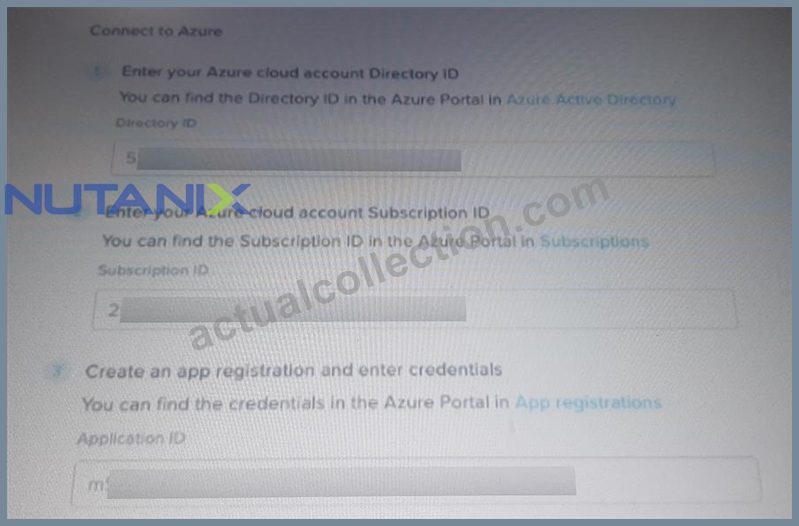
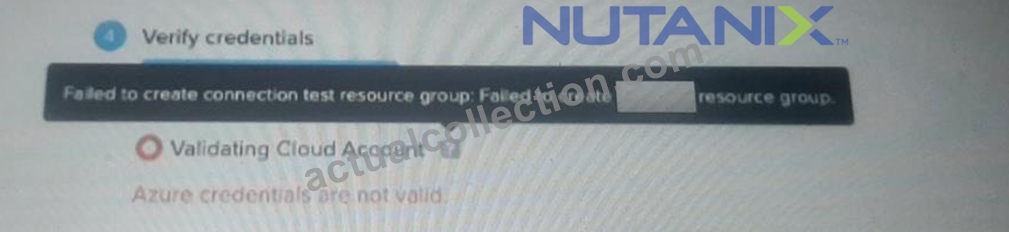
Which action should the administrator take to troubleshoot the error shown in the exhibit?
- A. Check the Azure AD App registration Client Secret.
- B. Check the NC2 organization permissions.
- C. Check the PC VNet is peered correctly.
- D. Check the Azure subnet delegation status.
Answer: A
Explanation:
To troubleshoot the error shown in the exhibit where Azure credentials are not valid and the creation of the resource group failed, the administrator should:
Verify that the Azure AD App registration has been correctly configured, especially the Client Secret.
Ensure that the Client Secret is valid, has not expired, and matches what has been entered in the configuration.
This step is crucial because an invalid or expired Client Secret would prevent the validation of Azure credentials and the creation of necessary resources.
Reference
Azure AD App Registration and Secrets Management
Nutanix Cluster Configuration Documentation
NEW QUESTION # 22
An administrator has been asked to create a cluster to support new workloads.
What are the maximum number of nodes supported in an NC2 on Azure environment?
- A. 14 nodes
- B. 28 nodes
- C. 24 nodes
- D. 18 nodes
Answer: D
Explanation:
NC2 Cluster Node Limit: NC2 on Azure has specific limitations regarding the maximum number of nodes supported in a single cluster.
Maximum Nodes: According to the current NC2 on Azure guidelines, a single cluster can support up to 18 nodes.
Workload Support: This limitation ensures optimal performance and management of resources within the Azure environment.
Comparison of Options:
14 nodes: Less than the maximum supported.
24 nodes and 28 nodes: Exceed the maximum supported, potentially leading to performance and management issues.
Conclusion: For supporting new workloads, the maximum number of nodes in an NC2 on Azure environment is 18.
Reference:
Nutanix Clusters on Azure Technical Specifications
Azure Virtual Machine Scale Sets Documentation
NEW QUESTION # 23
An administrator is tasked with allowing inbound connectivity for a user VM that resides on a NAT network. The ...... communicating successfully with other VMs in the NAT network.
The cluster has the following characteristics
A Transit VPC exists
* A User VPC exists
* A NAT subnet has been created
* 25 floating IP addresses are in use by other VMs
* Routes have been configured
When the administrator attempts to assign a floating IP address to the VM, none are available.
What is the reason for this?
- A. Additional floating IP addresses need to be requested.
- B. Geneve encapsulation only supports 25 Floating IP addresses.
- C. An external DHCP server needs to be deployed into the cluster.
- D. An additional Flow Gateway instance is required.
Answer: A
NEW QUESTION # 24
An administrator has been asked to create a cluster to support new workloads.
What are the maximum number of nodes supported in an NC2 on Azure environment?
- A. 14 nodes
- B. 28 nodes
- C. 24 nodes
- D. 18 nodes
Answer: D
Explanation:
* NC2 Cluster Node Limit: NC2 on Azure has specific limitations regarding the maximum number of nodes supported in a single cluster.
* Maximum Nodes: According to the current NC2 on Azure guidelines, a single cluster can support up to
18 nodes.
* Workload Support: This limitation ensures optimal performance and management of resources within the Azure environment.
* Comparison of Options:
* 14 nodes: Less than the maximum supported.
* 24 nodes and 28 nodes: Exceed the maximum supported, potentially leading to performance and management issues.
* Conclusion: For supporting new workloads, the maximum number of nodes in an NC2 on Azure environment is 18.
References:
* Nutanix Clusters on Azure Technical Specifications
* Azure Virtual Machine Scale Sets Documentation
NEW QUESTION # 25
A nutanix User VPC named Servers has a subnet named Tier1:
Servers: 10.0.0.0/20
Tier1: 10.0.0.0/25
Tier is using floating IPS to allow inbound traffic to the web servers that are hosted for a payroll system.
The company requires that the Network Security Group allow other Native Azure instances running in subnet AD (10.20.0.0/24) in the Prism Central VNet to be able to contact the web servers.
Which statement is true regarding this company requirement?
- A. The external NIC of the Flow Gateway Network Security Group needs to allow traffic from
10.20.0,0/24. - B. The internal NIC of the Flow Gateway Network Security Group needs to allow to traffic from 1
10.20.0.0/24. - C. Policy based routing in the Servers VPC must be edited to allow traffic from 10.20.0.0/24.
- D. Native Azure instances \n the Prism Central vNet will be allowed access by default.
Answer: B
Explanation:
* Flow Gateway Network Security Group (NSG):NSGs control the traffic flow to and from network interfaces associated with VMs and other resources. Configuring the NSG correctly is crucial for ensuring that required traffic is allowed.
* Internal NIC Configuration:To allow Native Azure instances in the Prism Central VNet (10.20.0.0/24) to access the web servers in the Tier1 subnet, the internal NIC of the Flow Gateway must be configured to allow traffic from 10.20.0.0/24. This ensures that inbound traffic from these instances is permitted and properly routed to the web servers.
References:
* Azure Network Security Group Documentation
* Nutanix Flow Gateway Configuration Guide
NEW QUESTION # 26
When configuring an alert email in Prism Central deployment within an NC2 environment, what is required in order for the emails to be sent properly?
- A. A whitelisted public cloud console endpoint
- B. Cluster Super Admin permissions
- C. Name servers configure in Prism Central
- D. SMTP server configured in Prism Central Settings
Answer: D
Explanation:
* SMTP Server Configuration:To send alert emails from Prism Central, it is essential to configure an SMTP server in the Prism Central settings. This server handles the email sending process, ensuring that alerts generated by Prism Central are properly delivered to the specified email addresses.
* Email Notification Setup:The SMTP server settings include the server address, port, and authentication details. Once these settings are correctly configured, Prism Central can use the SMTP server to send out alert emails reliably.
References:
* Nutanix Prism Central Administration Guide
* SMTP Configuration for Email Alerts in Prism Central
NEW QUESTION # 27
What will be observed in the NC2 cluster when terminating a node from the Azure portal?
- A. NC2 will continue re-provisioning the node.
- B. NC2 will mark the node as degraded.
- C. NC2 will terminate the node from the cluster.
- D. NC2 will shutdown the node.
Answer: B
Explanation:
* Node Termination Observation:When a node is terminated from the Azure portal, the NC2 cluster will detect that the node is no longer operational.
* Marking as Degraded:NC2 will mark the node as degraded, indicating that the node is not functioning as expected. This status allows administrators to take necessary actions to resolve the issue, such as provisioning a new node or addressing the degradation cause.
References:
* Nutanix NC2 Cluster Management Guide
* Azure Instance Termination Documentation
NEW QUESTION # 28
After creating a new Nutanix User VPC, what is needed to allow traffic to flow out of the Flow gateway VM when using the NATed Path?
- A. Add a default route on the Transit VPC of 0.0.0.0/0 to the Flow Gateway.
- B. Edit the External Flow Gateway Security Group on the External NIC to allow outbound traffic.
- C. Add a default route on the Nutanix User VPC of 0.0.0.0/0 to the External Overlay network.
- D. Edit the Internal Flow Gateway Security Group on the internal NIC to allow outbound taffic
- E. Add a default route on the Transit VPC of 0.0.0.0/0 to the Flow Gateway.
Answer: C
NEW QUESTION # 29
After creating a new Nutanix User VPC, what is needed to allow traffic to flow out of the Flow gateway VM when using the NATed Path?
- A. Add a default route on the Transit VPC of 0.0.0.0/0 to the Flow Gateway.
- B. Edit the External Flow Gateway Security Group on the External NIC to allow outbound traffic.
- C. Add a default route on the Nutanix User VPC of 0.0.0.0/0 to the External Overlay network.
- D. Add a default route on the Transit VPC of 0.0.0.0/0 to the Flow Gateway.
Answer: C
NEW QUESTION # 30
An administrator needs the permission to create and manage multiple organizations and clusters in NC2, as well as manage user access for the entire company.
What role should be assigned to meet the minimum requirements of this task?
- A. Organization Administrator
- B. Cluster Administrator
- C. Customer Security Administrator
- D. Customer Administrator
Answer: D
Explanation:
Role Requirements: The task involves creating and managing multiple organizations and clusters, along with managing user access across the company.
Role Capabilities: The "Customer Administrator" role is designed to provide extensive administrative capabilities, including:
Creating and managing organizations.
Managing clusters.
Handling user access and permissions.
Comparison of Roles:
Cluster Administrator: Primarily focuses on managing individual clusters but does not encompass organization-wide administrative tasks.
Customer Security Administrator: Focuses on security-related tasks and does not have broad administrative capabilities across organizations and clusters.
Organization Administrator: Manages organizational settings but might not cover all aspects needed for multiple clusters and user access management.
Conclusion: The "Customer Administrator" role meets all the requirements for managing organizations, clusters, and user access comprehensively.
Reference:
Nutanix Role-Based Access Control Documentation
NC2 on Azure User Roles Guide
NEW QUESTION # 31
Which address must Azure Directory Service be able to resolve when deploying a new NC2 cluster?
- A. Gateway-internal-api-cloud.nutanix.com
- B. Apikeys.nutanix.com
- C. Gateway-external-api.cloud.nutanix.com
- D. Download.cloud.nutanix.com
Answer: C
Explanation:
Azure Directory Service Role: Azure Directory Service must be able to resolve specific Nutanix URLs to ensure proper communication and functionality during the deployment of an NC2 cluster.
Critical Endpoint: The address "Gateway-external-api.cloud.nutanix.com" is critical for establishing external API communications required for the deployment and management of the NC2 cluster.
DNS Resolution: Proper DNS resolution of this address ensures that the Azure Directory Service can interact with Nutanix services and APIs necessary for cluster operations.
Verification Process:
Ensure that DNS settings allow resolution of "Gateway-external-api.cloud.nutanix.com".
Test connectivity and resolution prior to deployment to avoid issues.
Importance: Without resolving this address, the deployment process might face connectivity issues, leading to potential deployment failures.
Reference:
Nutanix NC2 on Azure Setup Guide
Azure Active Directory Integration
NEW QUESTION # 32
An administrator is seeking help with an ongoing NC2 issue. After reaching out to Nutanix support, the administrator is introduce to the NC2 specialist who can help troubleshoot the problem.
How can the administrator verify that the NC2 specialist has access to the necessary organizations?
- A. Ensure the specialist is assigned the RBAC role with proper permissions.
- B. Provide the specialist with the administrator's login credentials.
- C. Confirm the Support Authorization on the organization is set to Full Access.
- D. Add the specialist as an admin user to the organizations.
Answer: C
Explanation:
To verify that the NC2 specialist has access to the necessary organizations for troubleshooting the issue, the administrator should:
* Confirm that theSupport Authorizationon the organization is set toFull Access. This ensures that the NC2 specialist has the required permissions to access the necessary resources and perform the necessary actions to resolve the issue.
Providing login credentials or adding the specialist as an admin user is not recommended due to security and privacy concerns. Ensuring the specialist is assigned the correct RBAC role is another valid approach but confirming the support authorization directly ensures they have the needed access.
References
* Nutanix Support and Services
NEW QUESTION # 33
An administrator has been tasked with ensuring NC2 VMs are able to access Azure and on-premises resources. The NC2 VM traffic must not traverse the internet.
How can the administrator achieve this?
- A. By using an Interface Endpoint
- B. By using a Site-to-Site VPN
- C. By using an SSH connection
- D. By using ExpressRoute
Answer: D
Explanation:
Requirement Analysis: The NC2 VMs need to access Azure and on-premises resources without traversing the internet, ensuring secure and direct connectivity.
Solution Options:
SSH Connection: Suitable for individual remote access, not for full VM connectivity to Azure and on-premises resources.
Interface Endpoint: Facilitates private connectivity to specific Azure services, but not comprehensive for all resources.
ExpressRoute: Provides private, dedicated connectivity between Azure and on-premises environments. This ensures that traffic does not traverse the public internet, meeting the security and performance requirements.
Site-to-Site VPN: Provides secure connectivity but can involve traversing the internet, which is against the requirements.
Conclusion: ExpressRoute is the optimal solution as it offers a private connection that does not involve internet traversal, ensuring secure and efficient access to both Azure and on-premises resources.
Reference:
Azure ExpressRoute Documentation
Nutanix Clusters on Azure Networking Guide
NEW QUESTION # 34
Exhibit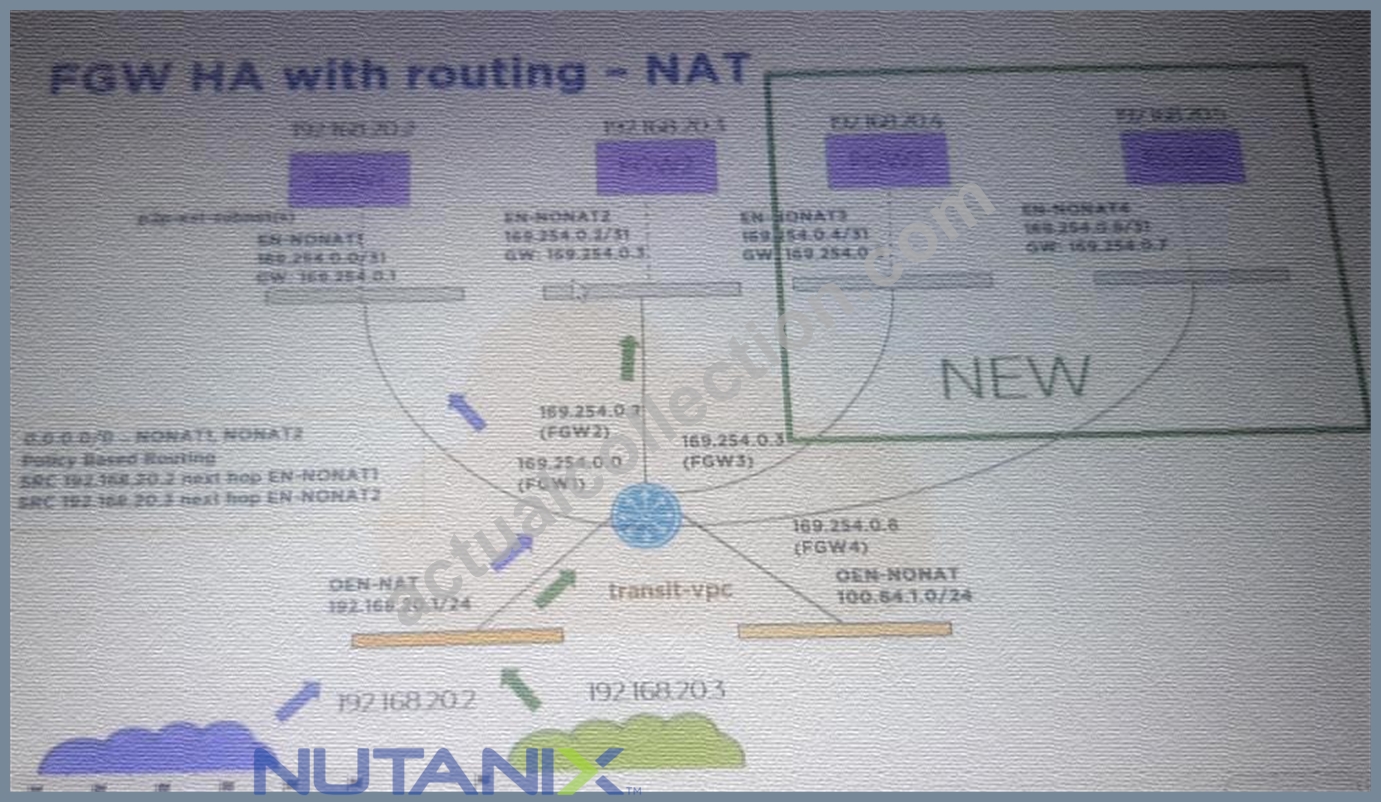
An NC2 on Azure cluster was deployed with two Flow Gateway in HA (FHW1 and FGW2). After a week of use, four bare-metal nodes were added to the NC2 cluster and additional workloads were added. The existing workloads were using floating IPs to allow inbound traffic to communicate with the running workloads on the NC2 cluster.
It was determined that additional bandwidth for north/south traffic would be needed. Two additional Flow Gateways were added (FGW3 and FGW4) from the NC2 portal configuration menu.
The existing workloads prior to expansion on the NC2 cluster will be able to use which Flow Gateways using the NAT traffic path after the expansion?
- A. All four Flow Gateways using a MAC/Hash algorithm.
- B. They will be able to use FGW3 and FGW4 once the NC2 workloads reboots.
- C. All four Flow Gateways.
- D. Only the Flow Gateway each workload was using prior to expansion.
Answer: D
Explanation:
In the NC2 on Azure cluster scenario, the existing workloads were using floating IPs for inbound traffic before the addition of new Flow Gateways (FGW3 and FGW4). The NAT traffic path established initially will continue to direct traffic through the originally assigned Flow Gateways (FGW1 and FGW2). The existing workloads will not automatically utilize the new Flow Gateways (FGW3 and FGW4) without a reconfiguration or reboot, which reassigns the NAT paths.
References
* Nutanix Flow Networking and Configuration Guide
NEW QUESTION # 35
An administrator has setup a routed external network (No NAT) to use for workload running in NC2 clusters on Azure.
The applications are network intensive, so four gateways VMs have been deployed to meet the high demands.
One application server on the NC2 clusters is sending traffic to an outside Azure service.
How many flow gateway VMs will be used to distribute the traffic?
- A. two flow gateway instances will be used based on limitations from using MAC addresses to redistribute traffic.
- B. All four Flow Gateway instances will be used based on the ECMP default route that points 3 the external subnets in the Nutanix Transit VPC, but only for sending traffic. Return traffic by use one Flow Gateway VM.
- C. All four Flow Gateway instances will be used based on the ECMP default route that points to the external subnets in the Nutanix Transit VPC for sending and receiving traffic.
- D. Only one Flow Gateway instance will be used per source application running on NC2.
Answer: C
Explanation:
* Equal-Cost Multi-Path (ECMP) Routing:ECMP allows multiple gateways to be used simultaneously for load balancing traffic across multiple paths. In this scenario, ECMP is configured to point to the external subnets in the Nutanix Transit VPC.
* Traffic Distribution:All four Flow Gateway instances will be used to distribute the outgoing traffic from the application server based on the ECMP default route configuration. This ensures efficient load balancing and utilization of all available gateway resources.
* Bidirectional Traffic:Both sending and receiving traffic will utilize all four Flow Gateway instances, ensuring high availability and performance for network-intensive applications.
References:
* Nutanix NC2 Networking Guide
* Azure Networking Documentation on ECMP
NEW QUESTION # 36
What is the minimum number of nodes needed to deploy an RF3 NC2 cluster?
- A. 0
- B. 1
- C. 2
- D. 3
Answer: C
Explanation:
* Replication Factor (RF3):RF3 requires that data is replicated across three different nodes to ensure data durability and fault tolerance. This replication scheme allows the system to tolerate the failure of two nodes simultaneously.
* Minimum Node Requirement for RF3:To meet the RF3 requirements while maintaining operational capability, a minimum of five nodes is necessary. This configuration ensures that there are enough nodes to distribute the data and provide the necessary redundancy.
References:
* Nutanix Replication Factor Documentation
* Nutanix NC2 on Azure Deployment Guide
NEW QUESTION # 37
An administrator is planning to expand an NC2 on Azure cluster.
Which statement is true regarding prerequisites for expanding the cluster?
- A. Cluster must be in a Cluster Connected state.
- B. Cluster must be in a Cluster Stopped state.
- C. Cluster must have at least five nodes.
- D. Cluster must have at least three nodes.
Answer: A
Explanation:
* Cluster State Requirement: To expand a cluster, it must be operational and in a connected state to ensure seamless integration of additional nodes.
* Cluster Stopped State: If the cluster is stopped, it cannot perform expansion operations.
* Minimum Nodes Requirement: There is no minimum node count prerequisite for expanding the cluster as long as the cluster is connected.
* Cluster Connected State: Ensuring the cluster is connected verifies that it is operational and can communicate with additional nodes being added.
* Conclusion: The cluster must be in a Cluster Connected state to expand successfully.
References:
* Nutanix Clusters Expansion Guide
* Azure NC2 Configuration Documentation
NEW QUESTION # 38
......
NCP-CI-Azure Dumps Updated Practice Test and 83 unique questions: https://quizguide.actualcollection.com/NCP-CI-Azure-exam-questions.html