

[Aug 01, 2025] 100% Pass Guarantee for NSE6_WCS-7.0 Dumps with Actual Exam Questions
Today Updated NSE6_WCS-7.0 Exam Dumps Actual Questions
To prepare for the Fortinet NSE6_WCS-7.0 exam, candidates are advised to have a strong understanding of AWS security best practices, network security, application security, and data protection. Candidates can also enroll in Fortinet's training courses and study materials to gain a deeper understanding of cloud security on AWS. By passing the Fortinet NSE6_WCS-7.0 certification exam, IT professionals can demonstrate their expertise in cloud security and advance their careers in this field.
NEW QUESTION # 19
What is the purpose of the created as part Of a FortiGate autoscale deployment using Fortinet cloud formation template in AWS?
- A. To Store the information used for the scale set.
- B. To store the traffic logs Of all FortiGates.
- C. To store information about varying states of auto scaling conditions.
- D. To store the firewall policies used by all FortiGates_
Answer: C
NEW QUESTION # 20
What is a drawback of deploying a FortiWeb VM inside a virtual public cloud (VPC) compared to FortiWeb Cloud?
- A. Only applications going through the VPC are protected.
- B. It is unable to support web applications from OWASP Top 10 threats.
- C. It is slower than FortiWeb Cloud to apply advanced WAF protection.
- D. It does not support zero-day protection.
Answer: A
Explanation:
* VPC-Scoped Protection:
* When deploying a FortiWeb VM inside a Virtual Private Cloud (VPC), the security and protection it offers are limited to the applications and traffic that pass through that specific VPC.
This means that any applications outside this VPC will not benefit from the protection of FortiWeb VM (Option D).
* Comparison with FortiWeb Cloud:
* FortiWeb Cloud, being a cloud-native WAF-as-a-Service, can protect applications regardless of their VPC location, offering broader and more flexible protection capabilities.
* Other Options Analysis:
* Option A is incorrect because both FortiWeb VM and FortiWeb Cloud protect against OWASP Top 10 threats.
* Option B is incorrect because FortiWeb VM does support zero-day protection.
* Option C is incorrect as the performance of FortiWeb VM in applying advanced WAF protection is not inherently slower compared to FortiWeb Cloud.
References:
* FortiWeb Overview: FortiWeb
NEW QUESTION # 21
Refer to the exhibit.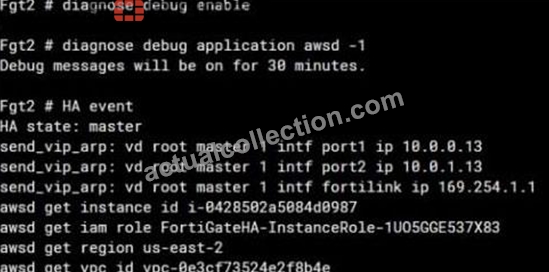
You deployed an active-passive FortiGate HA using a Cloud Formation template on an existing VPC_Now you want to test active-passive FortiGate HA failover by running a debug so you can see the API calls to change the elastic and secondary IP addresses.
Which statement is correct about the output of the debug?
- A. The elastic IP is associated with port1of Fgt2.
- B. The elastic IP is associated with port2 of Fgt2. and the secondary IP address for port1and port2 was updated successfully.
- C. The routing table for Fgt2 updated successfully. and port2 will provide internet access to Fgt2.
- D. IP address 10. O. O. L 3 is now associated with eni-Ob61d8afcOaefb8a2.
Answer: D
NEW QUESTION # 22
An administrator is adding a web application to be protected by FortiWeb Cloud.
Which two steps are necessary to successfully onboard the application? (Choose two.) An administrator is adding a web application to be protected by FortiWeb Cloud.
Which two steps are necessary to successfully onboard the application? (Choose two.)
- A. Wait for the EC2 instance to be created.
- B. Create DNS records in the domain server that hosts the application.
- C. Provide a web application name.
- D. Enable a content delivery network (CDN) in the same region where your application is located.
Answer: B,C
Explanation:
* Web Application Name:
* When onboarding a web application to be protected by FortiWeb Cloud, you need to provide a name for the web application. This helps in identifying and managing the application within the FortiWeb Cloud console (Option B).
* DNS Records:
* To ensure that traffic to your web application is correctly routed through FortiWeb Cloud, you must create DNS records in the domain server that hosts your application. This ensures that requests are directed to FortiWeb Cloud for inspection and protection (Option C).
* Other Considerations:
* Option A (Waiting for the EC2 instance) is incorrect as it is not a necessary step for onboarding a web application to FortiWeb Cloud.
* Option D (Enabling a CDN) is not a mandatory step for onboarding but can be part of a broader strategy for improving performance and protection.
References:
* FortiWeb Cloud Documentation: FortiWeb Cloud
NEW QUESTION # 23
Refer to the exhibit.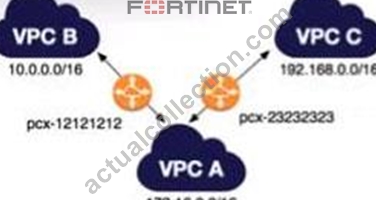
Which statement is correct about the VPC peering connections shown in the exhibit?
- A. You can associate VPC ID pcx-23232323 with VPC B to form a VPC peering connection between VPC B and VPC C.
- B. TO route packets directly from VPC B to VPC C through VPC A, you must add a route for network 192.168.0.0/16 in the VPC A routing table.
- C. You cannot route packets directly from VPC B to VPC C through VPC A.
- D. You cannot create a VPC peering connection between VPC B and VPC C to route packets directly.
Answer: C
NEW QUESTION # 24
An administrator has been asked to deploy an active-passive (A-P) FortiGate cluster in the AWS cloud across two availability zones.
In addition to enhanced redundancy, which other major difference is there compared to deploying A-P high availability in the same availability zone?
- A. The FortiGate devices act as a single, logical instance.
- B. IP addressing and subnetting are not shared.
- C. The number of subnets required is less.
- D. Secondary IP address configuration is used.
Answer: B
Explanation:
* Enhanced Redundancy:
* Deploying an active-passive (A-P) FortiGate cluster across two availability zones (AZs) provides enhanced redundancy by ensuring that if one AZ fails, the other can take over, maintaining high availability and uptime.
* IP Addressing and Subnetting:
* One of the major differences when deploying across different AZs compared to the same AZ is that IP addressing and subnetting are not shared between the instances. Each AZ operates independently with its own set of subnets and IP addresses, which must be managed separately (Option D).
* Other Options Analysis:
* Option A is incorrect because the FortiGate devices in an A-P setup do not act as a single logical instance; they operate in a failover setup.
* Option B is incorrect because secondary IP address configuration is used in both single AZ and multi-AZ deployments.
* Option C is incorrect because the number of subnets required is typically more when deploying across multiple AZs for redundancy.
References:
* FortiGate HA Configuration Guide: FortiGate HA
* AWS Availability Zones: AWS AZ
NEW QUESTION # 25
Refer to the exhibit.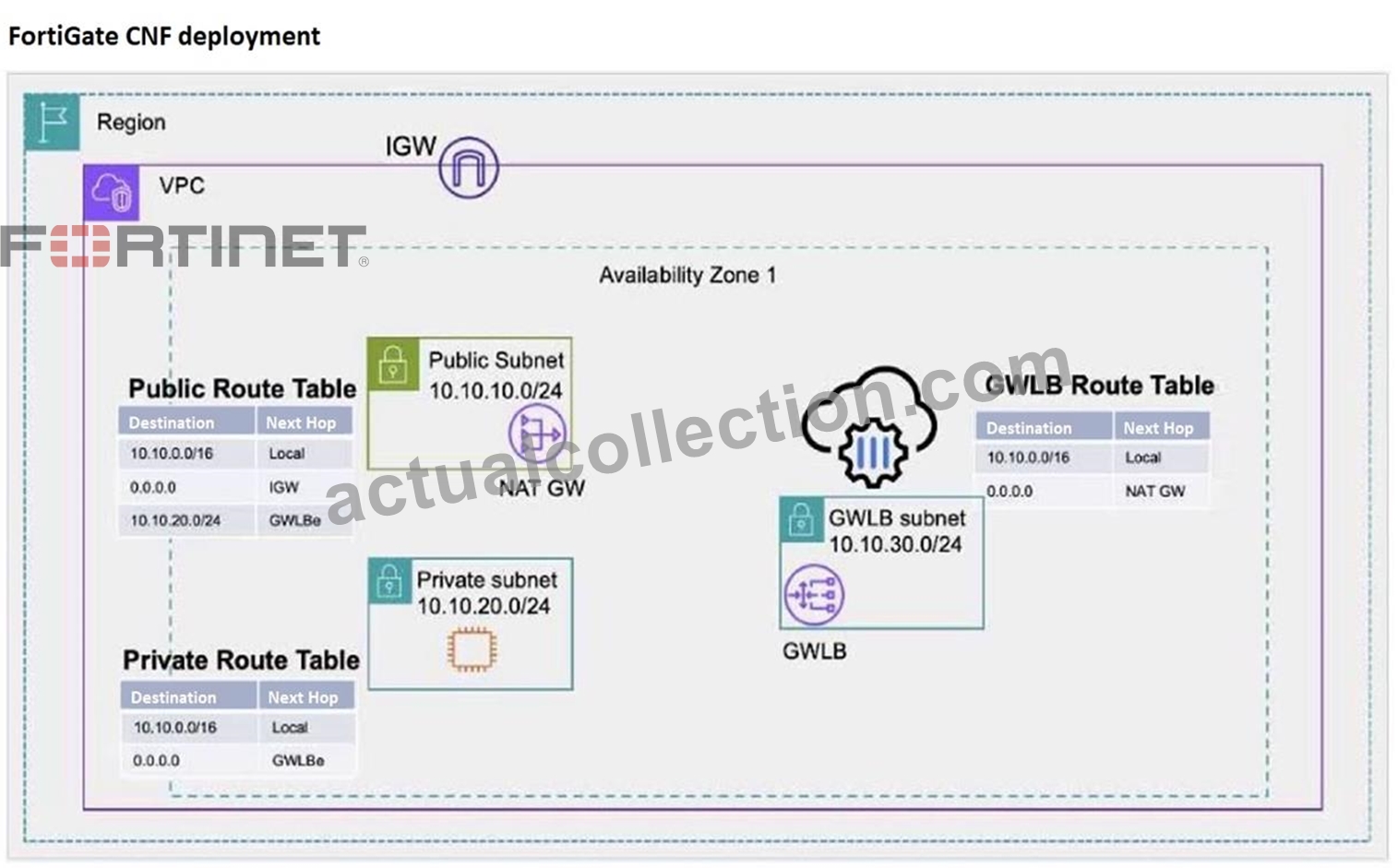
Traffic is initiated from the EC2 instance and is destined for the internet.
Which traffic flow is correct?
- A. EC2 instance > NAT GW > IGW > internet
- B. EC2 instance > GWLBe > internet
- C. EC2 instance > GWLBe > NAT GW > IGW > internet
- D. There is no route to the internet in the Private Route Table. The traffic does not reach the internet.
Answer: C
Explanation:
* Understanding the Architecture:
* The architecture includes an EC2 instance in a private subnet, a Gateway Load Balancer Endpoint (GWLBe), a NAT Gateway (NAT GW), and an Internet Gateway (IGW).
* Route Tables and Routing:
* The private route table for the subnet containing the EC2 instance has a route pointing to the GWLBe for internet-bound traffic.
* The public route table for the subnet containing the NAT Gateway has routes to the IGW.
* Traffic Flow Analysis:
* Traffic initiated from the EC2 instance destined for the internet will first be routed to the GWLBe as per the private route table.
* The GWLBe will forward the traffic to the NAT Gateway.
* The NAT Gateway will then route the traffic to the IGW, which finally sends the traffic to the internet.
* Comparison with Other Options:
* Option A suggests direct routing to the NAT GW from the EC2 instance, which is incorrect.
* Option B incorrectly states there is no route to the internet in the private route table.
* Option D suggests direct routing from GWLBe to the internet, which is not the case.
References:
* AWS Documentation on Route Tables: AWS Route Tables
* Gateway Load Balancer Overview: AWS Gateway Load Balancer
NEW QUESTION # 26
Refer to the exhibit.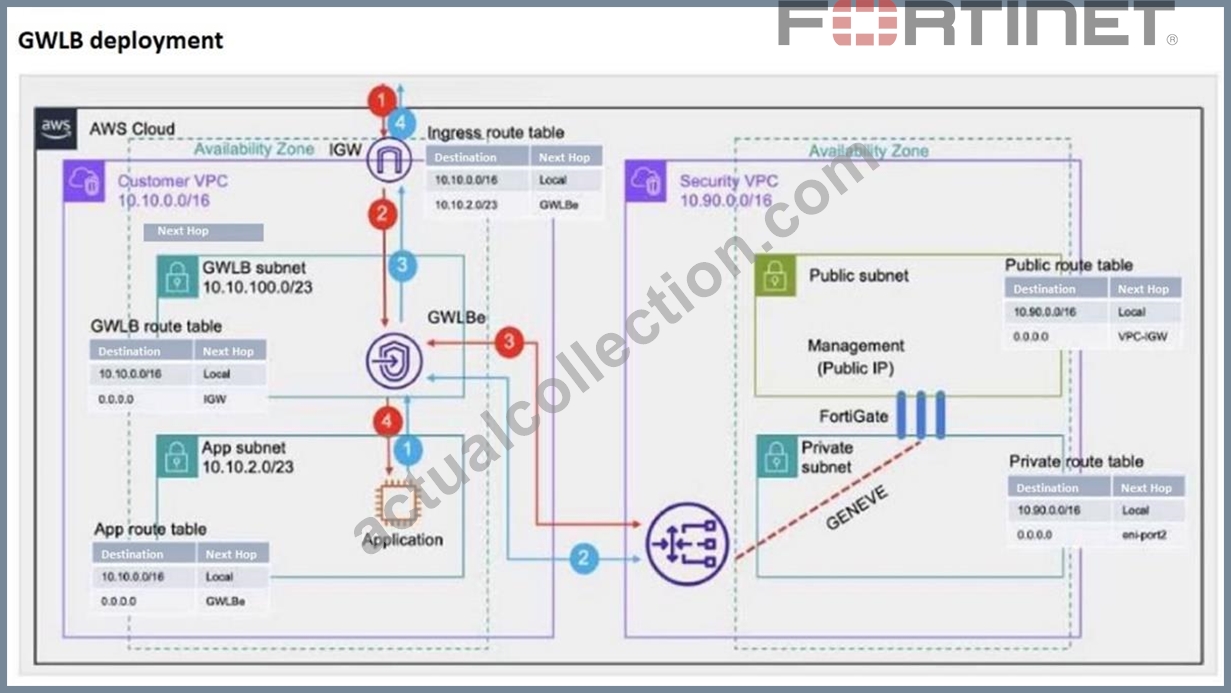
Which two statements are true about inbound traffic based on the IGW ingress route table and GWLB deployment shown in the exhibit? (Choose two.)
- A. Inbound traffic is directed to the application subnet through a GWLB endpoint.
- B. GWLB encapsulates traffic with the GENEVE protocol and sends it to FortiGate.
- C. Inbound traffic is directed to the GWLB through a GWLB endpoint.
- D. GWLB forwards traffic to FortiGate without encapsulation in its dedicated subnet.
Answer: B,C
Explanation:
* Traffic Direction through GWLB Endpoint:
* The ingress route table directs inbound traffic to the GWLB through a GWLB endpoint (GWLBe). This endpoint is responsible for directing traffic to the Gateway Load Balancer for further processing (Option B).
* GENEVE Encapsulation:
* The GWLB encapsulates the inbound traffic using the GENEVE protocol. This encapsulated traffic is then sent to FortiGate instances for security inspection. The use of GENEVE ensures that the original traffic context is preserved and can be analyzed by FortiGate (Option D).
* Other Options Analysis:
* Option A is incorrect because GWLB does not forward traffic without encapsulation in its dedicated subnet.
* Option C is incorrect as the inbound traffic is directed to the GWLB endpoint first, not directly to the application subnet.
References:
* AWS Gateway Load Balancer Documentation: AWS GWLB
* GENEVE Protocol Overview: GENEVE Protocol
NEW QUESTION # 27
An organization has created a VPC and deployed a FortiGate-VM (VM04 /c4.xlarge) in AWS, FortiGate-VM is initially configured With two Elastic Network Interfaces (ENIs). The primary ENI of FortiGate-VM is configured for a public subnet. and the second ENI is configured for a private subnet. In order to provide internet access. they now want to add an EIP to the primary ENI of FortiGate, but the EIP assignment is failing.
Which action would allow the EIP assignment to be successful?
- A. Create and attach a public routing table to the public subnet, associate the public subnet With the primary ENI Of FortiGate. and then assign the EP to the primary ENI.
- B. Create and attach an Internet gateway to the VPC. and then assign the EIP to the primary ENI Of FortiGate.
- C. Shut down the FortiGate VM. if it is running. assign the EIP to the primary ENI. and then power it on.
- D. Create and associate a public subnet With the primary ENI Of FortiGate, and then assign the EIP to the primary ENI.
Answer: B
NEW QUESTION # 28
A customer has deployed FortiGate Cloud-Native Firewall (CNF).
Which two statements are correct about policy sets? (Choose two.)
- A. Multiple policy sets can be applied to a single CNF instance.
- B. There is an implicit deny rule at the bottom of the policy set.
- C. A new policy set is created with each deployed CNF instance.
- D. The policy set must be manually synchronized to the CNF instance each time it is modified.
Answer: B,C
Explanation:
* Implicit Deny Rule:
* Similar to traditional firewall rule sets, FortiGate Cloud-Native Firewall (CNF) includes an implicit deny rule at the bottom of each policy set. This means any traffic that does not match an existing rule in the policy set is automatically denied (Option A).
* Policy Set Creation:
* When a new CNF instance is deployed, a new policy set is created specifically for that instance.
This ensures that each CNF instance can have a tailored set of security policies based on the specific needs of the deployment (Option C).
* Other Options Analysis:
* Option B is incorrect because policy sets do not require manual synchronization; they are applied automatically once configured.
* Option D is incorrect as a single CNF instance operates with a single policy set at a time.
References:
* FortiGate CNF Documentation: FortiGate CNF
* Firewall Policy Best Practices: Fortinet Policies
NEW QUESTION # 29
Refer to the exhibit.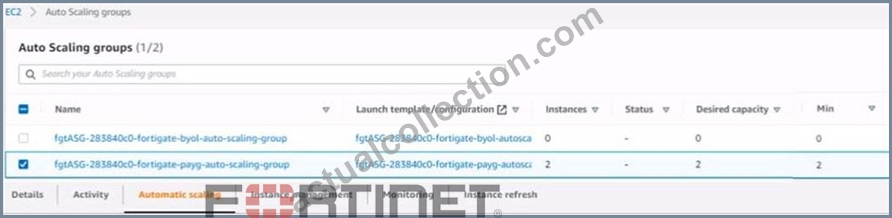
An administrator configured two auto-scaling polices that they now want to test.
What Will be the impact on payg-auto-scaling-group for the FortiGate devices if the administrator executes a scale-in policy?
- A. The scale-in policy will decrease the desired capacity from two to one
- B. The scale-in policy will decrease the number of maximum instances from four to three.
- C. The scale-in policy will decrease instances from two to one.
Answer: B
NEW QUESTION # 30
Which two statements are correct about AWS Network Access Control Lists (NACLS)? (Choose two.)
- A. NACLs are stateless: responses to allowed inbound traffic are subject to the rules for outbound traffic.
- B. VPC automatically comes with a modifiable default NACL, and by default it denies all inbound and outbound IPv4 traffic.
- C. An NACL has separate inbound and outbound rules, and each rule can either allow or deny traffic.
- D. By default. each custom NACL allows all inbound and outbound traffic unless you add new rules,
Answer: A,C
NEW QUESTION # 31
Refer to the exhibit.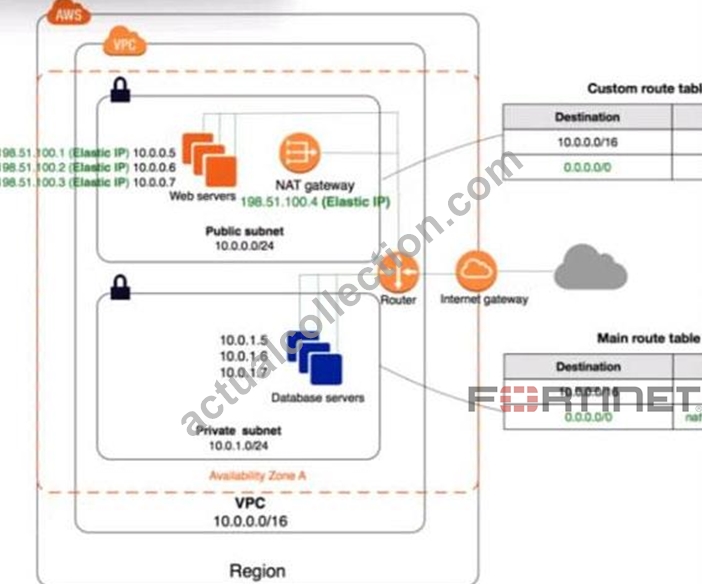
An administrator wants to update the database package from the Internet to a database server configured with IP address Which statement is correct about traffic from server IP address 10.0.1.7 to the internet. based on the diagrarm?
- A. Traffic from server10.0.1.7 to the internet will hide behind elastic IP 198.51.100.4
- B. Traffic from server 10.0.1.7 to the internet will hide behind elastic IP 198.51.100.1
- C. Traffic from server 10.0.1.7 to the internet will hide behind elastic IP 198.51.100 2.
- D. Traffic from server 10.0.1.7 to the internet will hide behind elastic IP 198.51.100.3
Answer: A
NEW QUESTION # 32
Which product you Can use as AWS WAF web access control lists (web ACLS) to minimize the effects Of a DDOS attack?
- A. AWS Shield
- B. AWS Protector
- C. AWS Inspector
- D. AWS GuardDuty
Answer: A
NEW QUESTION # 33
A cloud administrator is tasked with protecting web applications hosted in AWS cloud.
Which three Fortinet cloud offerings can the administrator choose from to accomplish the task? (Choose three.)
- A. FortiEDR
- B. AWS WAF
- C. Fortinet Managed Rules for AWS WAF
- D. FortiGate Cloud-Native Firewall (CNF)
- E. FortiWeb Cloud
Answer: C,D,E
Explanation:
* FortiGate Cloud-Native Firewall (CNF):
* FortiGate CNF offers cloud-native firewall capabilities designed to provide network security within AWS. It integrates seamlessly with AWS services and offers advanced threat protection and traffic management (Option C).
* Fortinet Managed Rules for AWS WAF:
* Fortinet Managed Rules for AWS WAF provide pre-configured, updated security rules that protect web applications from common threats such as SQL injection and cross-site scripting.
This offering simplifies the protection of web applications hosted on AWS (Option D).
* FortiWeb Cloud:
* FortiWeb Cloud is a Web Application Firewall (WAF) as a service that provides comprehensive protection for web applications hosted on AWS. It offers features such as bot mitigation, DDoS protection, and deep inspection of HTTP/HTTPS traffic (Option E).
* Comparison with Other Options:
* Option A (AWS WAF) is a native AWS service, not a Fortinet offering.
* Option B (FortiEDR) is focused on endpoint detection and response, which is not specifically aimed at protecting web applications.
References:
* FortiGate CNF Documentation: FortiGate CNF
* Fortinet Managed Rules for AWS WAF: Fortinet AWS WAF Rules
* FortiWeb Cloud Overview: FortiWeb Cloud
NEW QUESTION # 34
You are network connectivity issues between two VMS deployed in AWS. One VM is a FortiGate located on subnet *LAN- that is part Of the VPC "Encryption". The Other VM is a Windows server located on the subnet "servers" Which is also in the "Encryption" VPC. You are unable to ping the Windows server from FortiGate.
What is the reason for this?
- A. You have not created a VPN to allow traffic between those subnets.
- B. By default. AWS does not allow ICMP traffic between subnets.
- C. The default AWS Network Access Control List (NACL) does not allow this traffic.
- D. The firewall in the Windows VM is blocking the traffic.
Answer: D
NEW QUESTION # 35
......
To prepare for the Fortinet NSE 6 - Cloud Security 7.0 for AWS exam, candidates can take advantage of various training resources such as official Fortinet training courses, online training modules, and practice exams. These resources can help candidates develop a deeper understanding of the exam topics and improve their chances of passing the exam on their first attempt.
Fortinet NSE6_WCS-7.0 certification exam is designed to evaluate the knowledge and skills of individuals in cloud security for Amazon Web Services (AWS). NSE6_WCS-7.0 exam serves as proof of proficiency in securing cloud-based architectures and is highly valued by employers in the IT industry. The Fortinet NSE6_WCS-7.0 exam is suitable for professionals working with cloud security in AWS and seeking to validate their skills and knowledge in the field.
NSE6_WCS-7.0 exam dumps with real Fortinet questions and answers: https://quizguide.actualcollection.com/NSE6_WCS-7.0-exam-questions.html