

2026 Realistic Verified Free Pegasystems PEGACPDC25V1 Exam Questions
PEGACPDC25V1 Real Exam Questions and Answers FREE
NEW QUESTION # 16
U+ Bank's marketing department currently promotes various credit card offers by sending emails to qualified customers. The bank wants to limit the number of offers that customers can receive over a given period of time.
In the Answer Area, select the correct artifact you use to implement each requirement.
Answer:
Explanation:
Explanation:
A screenshot of a computer screen AI-generated content may be incorrect.
NEW QUESTION # 17
What does a dotted line from a "Group By" component to a "Filter" component mean?
- A. To evaluate the "Group By" component, the "Filter" component is evaluated first.
- B. There is a one-to-one relationship between the "Group By" and the "Filter" components.
- C. A property from the "Group By" is referenced by the "Filter" component.
- D. Information from the "Group By" is copied over to the "Filter" component.
Answer: C
NEW QUESTION # 18
U+ Bank, a retail bank, is facing an unforeseen technical issue with its customer care system. As a result, the bank wants to share the new temporary contact details with all customers over an SMS. All customers must receive this communication regardless of the engagement policy conditions and constraints.
Which type of communication do you configure to implement this requirement?
- A. Mandatory action
- B. One-time action
- C. Promotional action
- D. Transactional action
Answer: B
NEW QUESTION # 19
MyCo, a telecom company, developed a new data plan group to suit the needs of its customers. The following table lists the three data plan actions and the criteria that customers must satisfy to qualify for the offer:
Answer:
Explanation:
Explanation:
A screenshot of a computer screen AI-generated content may be incorrect.
NEW QUESTION # 20
U+ Bank, a retail bank, has recently implemented Pega Customer Decision Hub. The bank currently uses an external tool to design email content and a third-party email service provider to send emails to its customers.
As a decisioning architect, how do you recommend the bank implements this requirement?
- A. Create an internal email treatment and import the email content HTML.
- B. Create an external email treatment and use an external tool to design the email.
- C. Create an Internal email treatment and use Customer Decision Hub to design the email.
- D. Create an external email treatment and use Customer Decision Hub to design the email.
Answer: B
NEW QUESTION # 21
An outbound run identifies 150 Standard card offers, 75 on email, and 75 on the SMS channel. If the following volume constraint Is applied, how many actions are delivered by the outbound run?
- A. 75 SMSes and 25 emails
- B. 0
- C. 75 emails 25 SMSes
- D. 1
Answer: D
NEW QUESTION # 22
MyCo,a telecom company, recently introduced a new mobile handset offer, MyFone 14 Pro, for its premium customers. As the bank has financial targets to meet, the business decides to boost the MyFone 14 Pro offer.
As a decisioning architect, how can you ensure that the MyFonel4 Pro offer is prioritized over other offers7
- A. Increase the starting propensity of the MyFone 14 Pro offer.
- B. Increase the context weight of the MyFone 14 Pro offer.
- C. Increase the business value of the MyFone 14 Pro offer.
- D. Increase the business weight of the MyFone 14 Pro offer.
Answer: D
NEW QUESTION # 23
In a decision strategy, to use a customer property in an expression, you
- A. prefix the property with the keyword Customer
- B. define Customer page in Pages & Classes
- C. define the property as a strategy property
- D. use the property as defined without any prefix
Answer: B
Explanation:
In a decision strategy, to use a customer property in an expression, you need to define Customer page in Pages
& Classes and specify its class as Data-Customer. This allows you to access customer properties by using dot notation, such as Customer.Age or Customer.Gender. You do not need to define the property as a strategy property, use it without any prefix, or prefix it with the keyword Customer. Verified References: [Certified Pega Decisioning Consultant | Pega Academy], Decision strategies
NEW QUESTION # 24
MyCo, a mobile company, uses Pega Customer Decision Hub to display offers to customers on its website.
The company wants to present more relevant offers to customers based on customer behavior. The following diagram is the action hierarchy in the Next-Best-Action Designer.
The company wants to present offers from both the groups and arbitrate across the two groups to select the best offer based on customer behavior.
As a decisioning architect, what must you do to present offers from the two groups?
- A. Map a real-time container to the Top-level or Issue-level.
- B. Enable an engagement policy for the second group.
- C. Create a decision strategy at the Issue-level
- D. Set contact limits for both the groups.
Answer: A
Explanation:
To present offers from the two groups, you must map a real-time container to the Top-level or Issue-level. A real-time container is a configuration that defines how to deliver offers and treatments to a specific channel, such as a website or a mobile app. By mapping a real-time container to the Top-level or Issue-level, you can enable all the offers under that level to be available for delivery through that channel. Verified References: Pega Academy - Decisioning Consultant - Configuring real-time containers
NEW QUESTION # 25
Acme Retail uses Pega Customer Decision Hub to present various offers to its customers. The company notices that some high-value customers are not receiving any offers. The marketing team wants to identify these underserved customers.
Which tool in Pega Customer Decision Hub can Acme Retail use to identify segments of customers who are not receiving relevant offers?
- A. Scenario Planner
- B. Value Finder
- C. CDH Assistant
- D. Application Overview
Answer: B
NEW QUESTION # 26
U+ Bank, a retail bank, has recently implemented a project in which credit card offers are presented to qualified customers when they log in to the web self-service portal. The bank added engagement policy conditions to show the offers based on the bank's requirements.
In the Answer Area, select the correct engagement policy for each condition.
Answer:
Explanation:
Explanation:
A screenshot of a survey AI-generated content may be incorrect.
NEW QUESTION # 27
What is the name of the property that the system computes automatically when you use an Adaptive Model decision component?
- A. Order
- B. Priority
- C. Propensity
- D. Rank
Answer: C
Explanation:
Propensity is the name of the property that the system computes automatically when you use an Adaptive Model decision component. Propensity is a measure of how likely a customer is to accept an action, based on their past behavior and profile. An Adaptive Model component uses machine learning to calculate the propensity for each action and store it in a property with the same name as the action. Verified References: Pega Academy - Decisioning Consultant - Using adaptive models
NEW QUESTION # 28
MyCo, a mobile company, uses Pega Customer Decision Hub'" to display offers to customers on its website.
The company wants to present more relevant offers to customers based on customer behavior. The following diagram is the action hierarchy in the Next-Best-Action Designer.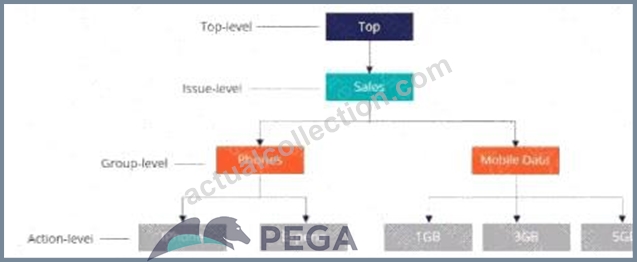
The company wants to present offers from both the groups and arbitrate across the two groups to select the best offer based on customer behavior.
As a decisioning architect, what must you do to present offers from the two groups'
- A. Map a real-time container to the Top-level or Issue-level.
- B. Enable an engagement policy for the second group.
- C. Set contact limits for both the groups.
- D. Create a decision strategy at the Issue-level.
Answer: A
NEW QUESTION # 29
U+- Bank, a retail bank, has recently Implemented a project in which qualified customers see mortgage offers when they log in to the web self-service portal.
Currently, only the customers who satisfy the following engagement policy conditions receive the Fifteen- year fixed-rate mortgage offer:
The bank decides to make two changes:
1. Update the suitability condition for the Fifteen-year fixed-rate mortgage offer.
2. Introduce a new offer, Twenty-year fixed-rate mortgage.
The following table shows the new engagement policy conditions for both mortgage offers:
What is the best practice to fulfill this change management requirement in the business operations environment?
- A. Create a single change request in the 1:1 Operations Manager portal.
- B. Create two change requests in the 1:1 Operations Manager portal.
- C. Create a single change request in the Pega Customer Decision Hub portal.
- D. Create two change requests: one in the Pega Customer Decision Hub portal and the other in the 1:1 Operations Manager portal.
Answer: B
NEW QUESTION # 30
A bank has been running traditional marketing campaigns for many years. One such campaign sends an offer email to qualified customers on day one. On day five, the bank presents a similar offer if the first email is ignored.
If you re-implement this requirement by using the always-on outbound customer engagement paradigm, how do you approach this scenario?
- A. Configure the primary schedule to run daily and let the artificial intelligence (AI) choose the best action based on engagement policies.
- B. Create two segments to identify the target audience for each of the two offer emails: day one, and day five. Set up two schedules per day for the two segments.
- C. Configure a primary schedule for the original offer email and setup an ad-hoc schedule to send the second email.
- D. Create an action with a flow that contains two Send Email shapes, one for each email. Set appropriate wait times between the shapes.
Answer: A
Explanation:
The always-on outbound customer engagement paradigm relies on AI to select the best action for each customer at any given time, based on their profile, context, and behavior. You do not need to create separate segments or schedules for different offers or timings. You can configure the primary schedule to run daily and let the AI choose the best action based on engagement policies, such as contact policies, eligibility rules, suitability rules, and arbitration. The AI will also learn from the customer responses and optimize the action selection over time.
NEW QUESTION # 31
U+ Bank implemented a customer journey for its customers. The journey consists of three stages. The first stage raises awareness about available products, the second stage presents available offers, and in the last stage, customers can talk to an advisor to get a personalized quote. The bank wants to actively increase offers promotion over time.
What action does the bank need to take to achieve this business requirement?
- A. Enable constant stage upweighting for the second stage of the journey.
- B. Enable increasing stage upweighting for the first stage of the journey.
- C. Enable increasing stage upweighting for the second stage of the journey.
- D. Upweight the propensity by adding more predictors that fit the target customers and repeat this process over time.
Answer: C
Explanation:
Increasing stage upweighting is a feature that allows you to gradually increase the weight of a stage over time, making the offers in that stage more likely to be selected. This is useful for promoting offers that are time- sensitive or have a limited availability. In this case, the bank wants to actively increase offers promotion over time, so enabling increasing stage upweighting for the second stage of the journey, where the offers are presented, is the best option. Verified References: [Pega Decisioning Consultant | Pega Academy]
NEW QUESTION # 32
......
Exam Dumps PEGACPDC25V1 Practice Free Latest Pegasystems Practice Tests: https://quizguide.actualcollection.com/PEGACPDC25V1-exam-questions.html