

DP-203 Dumps PDF New [2024] Ultimate Study Guide
DP-203 Exam Dumps PDF Updated Dump from ActualCollection Guaranteed Success
The Data Engineering on Microsoft Azure certification exam is an excellent choice for professionals who want to demonstrate their expertise in data engineering on Azure. Data Engineering on Microsoft Azure certification is globally recognized and is highly valued by employers. DP-203 exam is also an excellent opportunity for professionals to enhance their skills and knowledge in data engineering on Azure, allowing them to take on more challenging roles in their organizations.
Microsoft DP-203 certification exam consists of various topics, including designing and implementing data storage solutions, designing and implementing data processing solutions, monitoring and optimizing data solutions, and designing and implementing data security. DP-203 exam is divided into two sections, where the first section includes multiple-choice questions, while the second section requires candidates to complete a practical task related to the topics covered in the exam.
NEW QUESTION # 78
You are designing an Azure Databricks table. The table will ingest an average of 20 million streaming events per day.
You need to persist the events in the table for use in incremental load pipeline jobs in Azure Databricks. The solution must minimize storage costs and incremental load times.
What should you include in the solution?
- A. Include a watermark column.
- B. Partition by DateTime fields.
- C. Use a JSON format for physical data storage.
- D. Sink to Azure Queue storage.
Answer: D
Explanation:
The Databricks ABS-AQS connector uses Azure Queue Storage (AQS) to provide an optimized file source that lets you find new files written to an Azure Blob storage (ABS) container without repeatedly listing all of the files.
This provides two major advantages:
Lower latency: no need to list nested directory structures on ABS, which is slow and resource intensive.
Lower costs: no more costly LIST API requests made to ABS.
Reference:
https://docs.microsoft.com/en-us/azure/databricks/spark/latest/structured-streaming/aqs
NEW QUESTION # 79
You have an Azure subscription that contains the following resources:
* An Azure Active Directory (Azure AD) tenant that contains a security group named Group1.
* An Azure Synapse Analytics SQL pool named Pool1.
You need to control the access of Group1 to specific columns and rows in a table in Pool1 Which Transact-SQL commands should you use? To answer, select the appropriate options in the answer area.
NOTE: Each appropriate options in the answer area.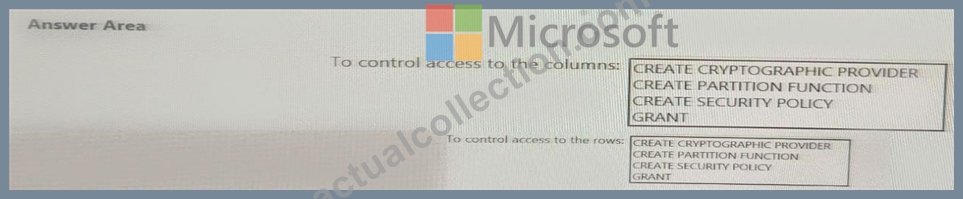
Answer:
Explanation:
NEW QUESTION # 80
You are designing an application that will store petabytes of medical imaging data When the data is first created, the data will be accessed frequently during the first week. After one month, the data must be accessible within 30 seconds, but files will be accessed infrequently. After one year, the data will be accessed infrequently but must be accessible within five minutes.
You need to select a storage strategy for the dat
a. The solution must minimize costs.
Which storage tier should you use for each time frame? To answer, select the appropriate options in the answer area.
NOTE: Each correct selection is worth one point.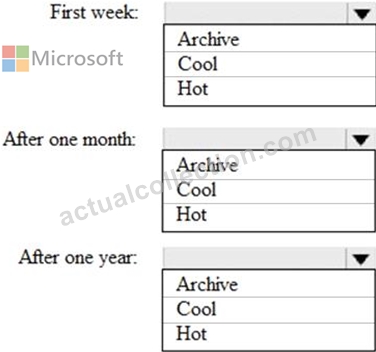
Answer:
Explanation: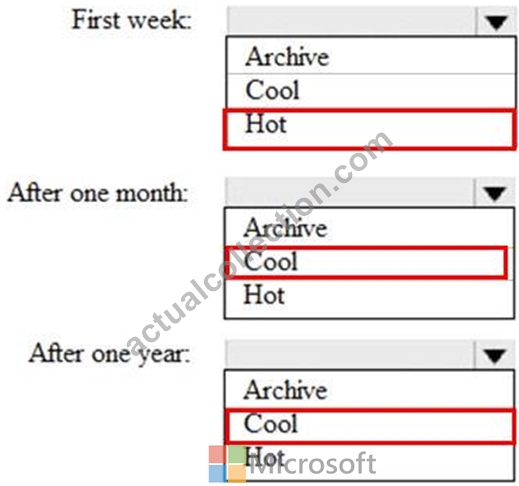
Reference:
https://docs.microsoft.com/en-us/azure/storage/blobs/storage-blob-storage-tiers
NEW QUESTION # 81
A company plans to use Platform-as-a-Service (PaaS) to create the new data pipeline process. The process must meet the following requirements:
Ingest:
Access multiple data sources.
Provide the ability to orchestrate workflow.
Provide the capability to run SQL Server Integration Services packages.
Store:
Optimize storage for big data workloads.
Provide encryption of data at rest.
Operate with no size limits.
Prepare and Train:
Provide a fully-managed and interactive workspace for exploration and visualization.
Provide the ability to program in R, SQL, Python, Scala, and Java.
Provide seamless user authentication with Azure Active Directory.
Model & Serve:
Implement native columnar storage.
Support for the SQL language
Provide support for structured streaming.
You need to build the data integration pipeline.
Which technologies should you use? To answer, select the appropriate options in the answer area.
NOTE: Each correct selection is worth one point.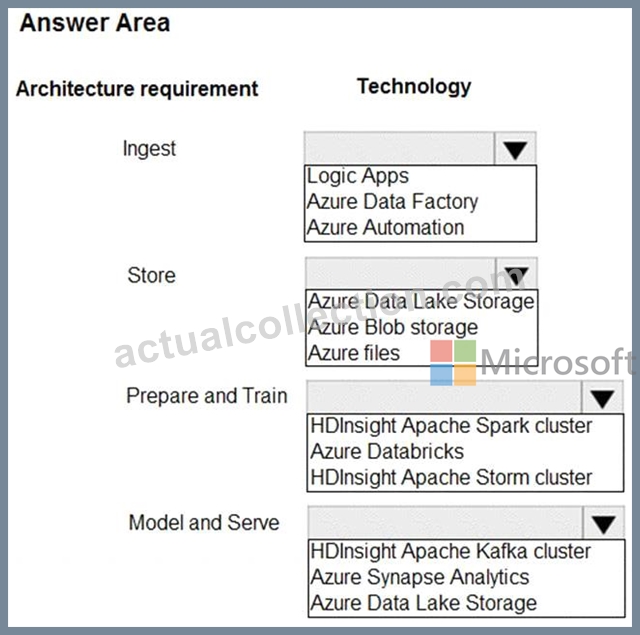
Answer:
Explanation: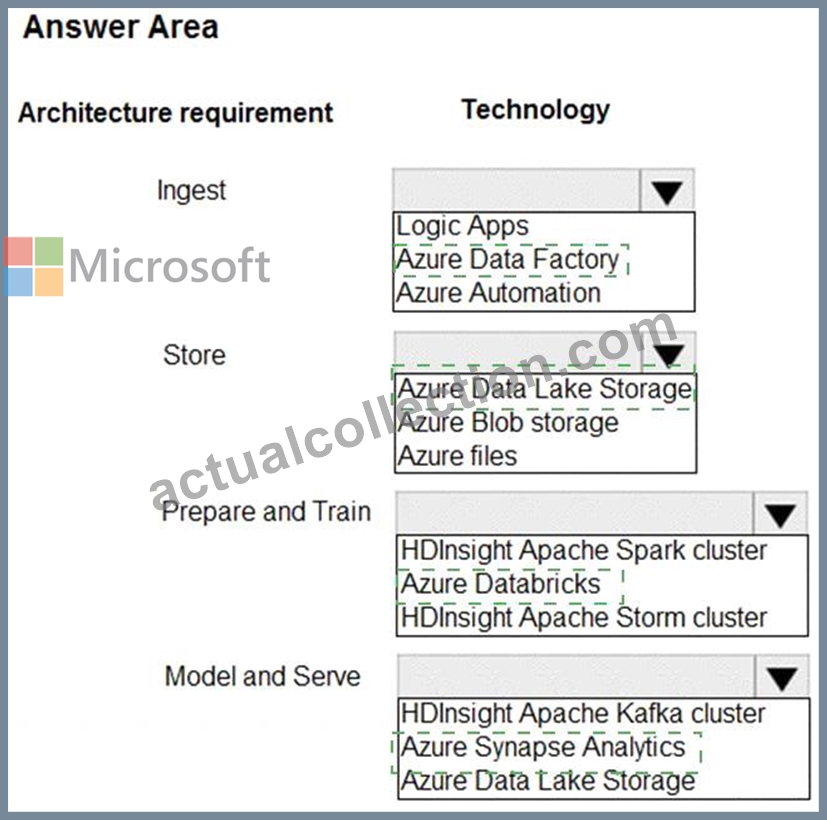
Explanation
Graphical user interface, application, table, email Description automatically generated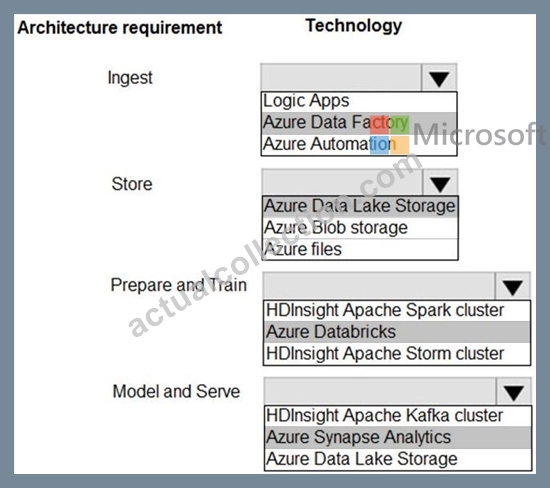
NEW QUESTION # 82
You have an Azure Data Factory pipeline that has the activities shown in the following exhibit.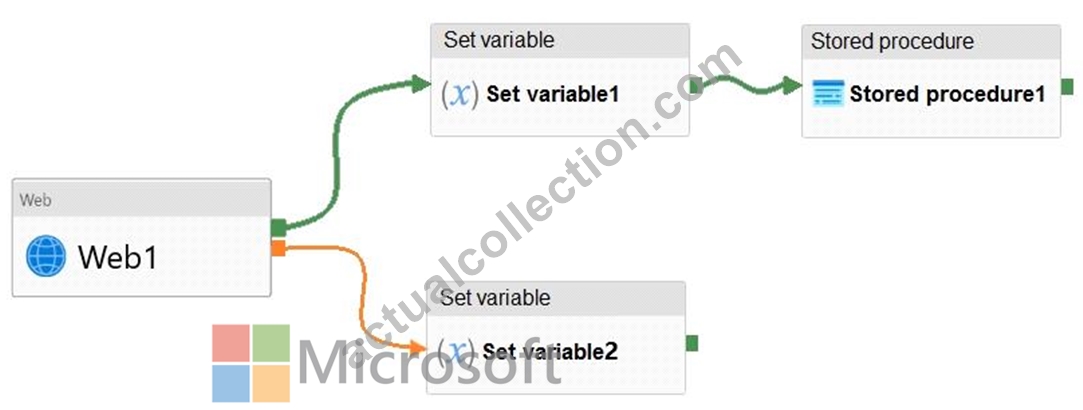
Use the drop-down menus to select the answer choice that completes each statement based on the information presented in the graphic.
NOTE: Each correct selection is worth one point.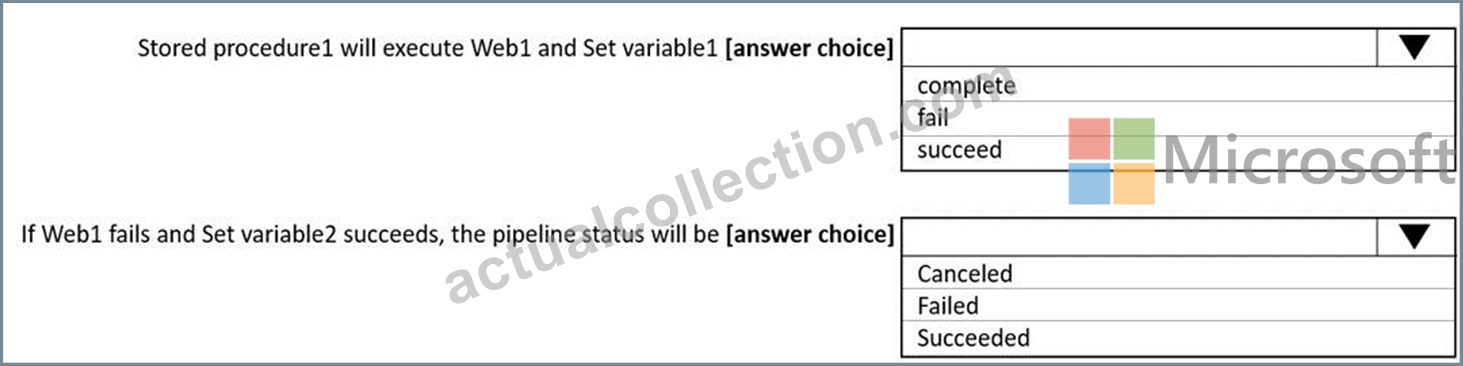
Answer:
Explanation: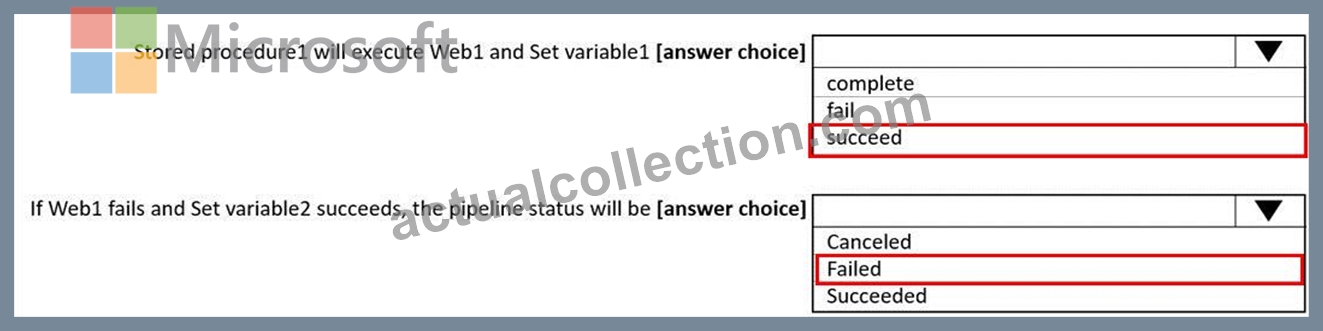
Reference:
https://datasavvy.me/2021/02/18/azure-data-factory-activity-failures-and-pipeline-outcomes/
NEW QUESTION # 83
You use Azure Data Factory to prepare data to be queried by Azure Synapse Analytics serverless SQL pools.
Files are initially ingested into an Azure Data Lake Storage Gen2 account as 10 small JSON files. Each file contains the same data attributes and data from a subsidiary of your company.
You need to move the files to a different folder and transform the data to meet the following requirements:
Provide the fastest possible query times.
Automatically infer the schema from the underlying files.
How should you configure the Data Factory copy activity? To answer, select the appropriate options in the answer area.
NOTE: Each correct selection is worth one point.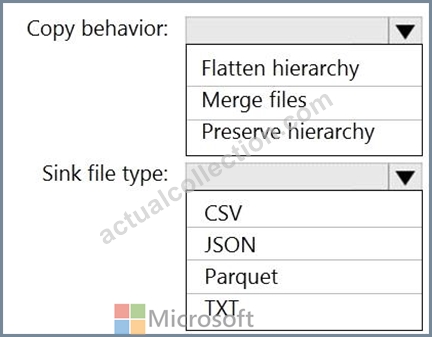
Answer:
Explanation: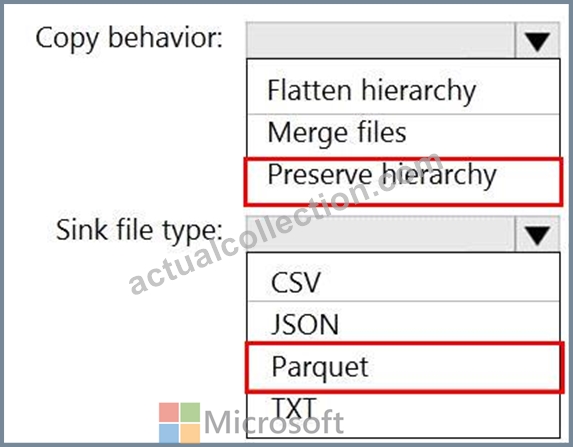
Reference:
https://docs.microsoft.com/en-us/azure/storage/blobs/data-lake-storage-introduction
https://docs.microsoft.com/en-us/azure/data-factory/format-parquet
NEW QUESTION # 84
You have an Azure subscription that contains an Azure Data Lake Storage account. The storage account contains a data lake named DataLake1.
You plan to use an Azure data factory to ingest data from a folder in DataLake1, transform the data, and land the data in another folder.
You need to ensure that the data factory can read and write data from any folder in the DataLake1 file system.
The solution must meet the following requirements:
* Minimize the risk of unauthorized user access.
* Use the principle of least privilege.
* Minimize maintenance effort.
How should you configure access to the storage account for the data factory? To answer, select the appropriate options in the answer area.
NOTE: Each correct selection is worth one point.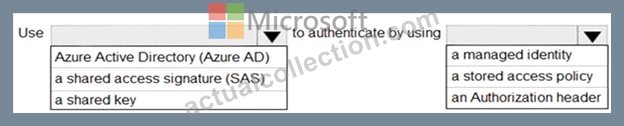
Answer:
Explanation: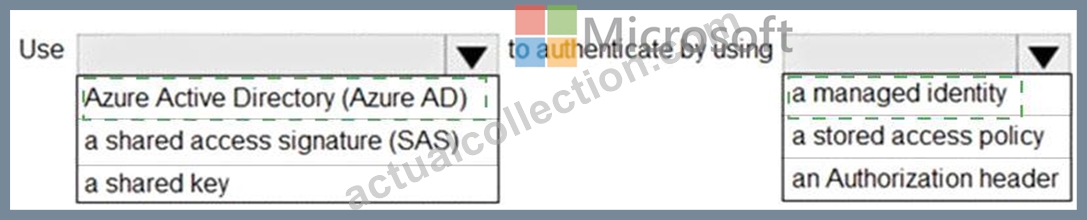
Explanation
Text Description automatically generated with low confidence
Box 1: Azure Active Directory (Azure AD)
On Azure, managed identities eliminate the need for developers having to manage credentials by providing an identity for the Azure resource in Azure AD and using it to obtain Azure Active Directory (Azure AD) tokens.
Box 2: a managed identity
A data factory can be associated with a managed identity for Azure resources, which represents this specific data factory. You can directly use this managed identity for Data Lake Storage Gen2 authentication, similar to using your own service principal. It allows this designated factory to access and copy data to or from your Data Lake Storage Gen2.
Note: The Azure Data Lake Storage Gen2 connector supports the following authentication types.
* Account key authentication
* Service principal authentication
* Managed identities for Azure resources authentication
Reference:
https://docs.microsoft.com/en-us/azure/active-directory/managed-identities-azure-resources/overview
https://docs.microsoft.com/en-us/azure/data-factory/connector-azure-data-lake-storage
NEW QUESTION # 85
You are designing an Azure Data Lake Storage Gen2 structure for telemetry data from 25 million devices distributed across seven key geographical regions. Each minute, the devices will send a JSON payload of metrics to Azure Event Hubs.
You need to recommend a folder structure for the dat
a. The solution must meet the following requirements:
Data engineers from each region must be able to build their own pipelines for the data of their respective region only.
The data must be processed at least once every 15 minutes for inclusion in Azure Synapse Analytics serverless SQL pools.
How should you recommend completing the structure? To answer, drag the appropriate values to the correct targets. Each value may be used once, more than once, or not at all. You may need to drag the split bar between panes or scroll to view content.
NOTE: Each correct selection is worth one point.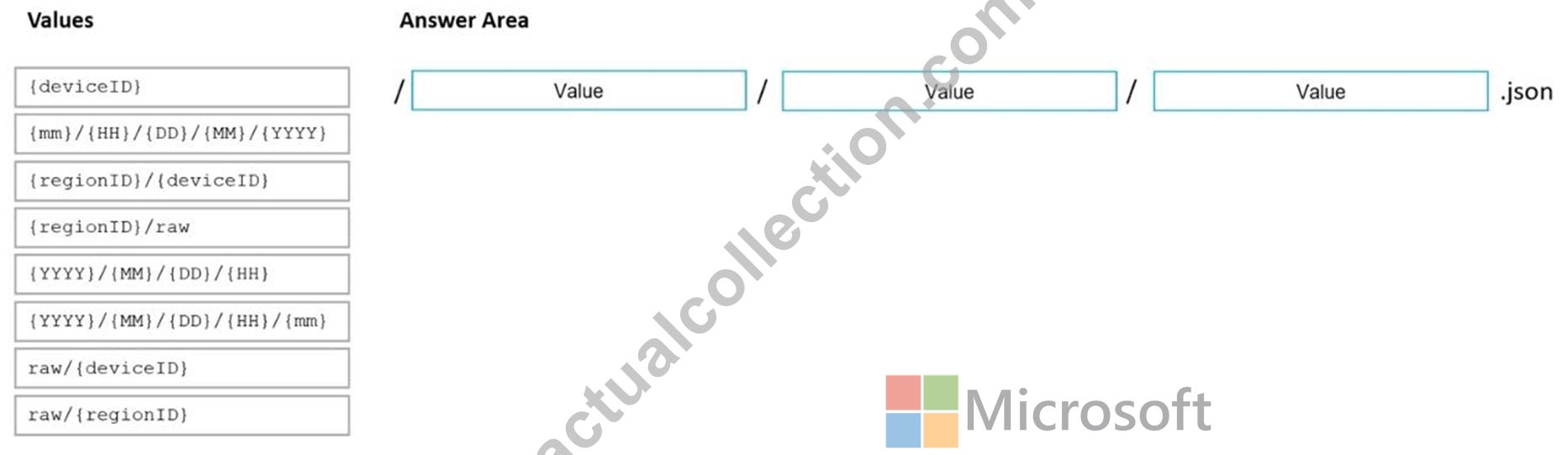
Answer:
Explanation: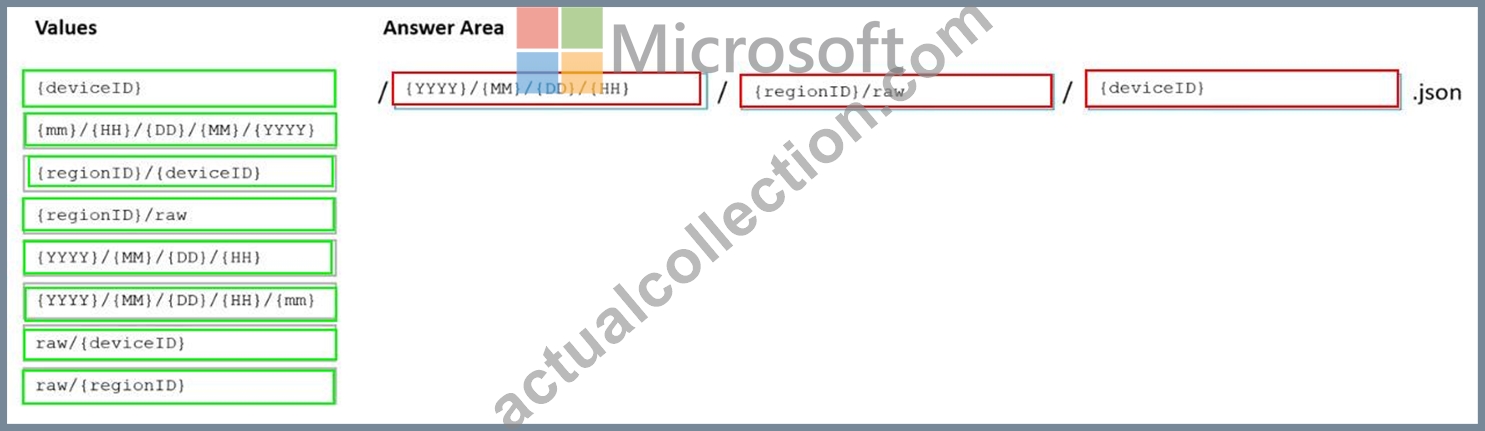
Reference:
https://github.com/paolosalvatori/StreamAnalyticsAzureDataLakeStore/blob/master/README.md
NEW QUESTION # 86
You have an Azure subscription.
You need to deploy an Azure Data Lake Storage Gen2 Premium account. The solution must meet the following requirements:
* Blobs that are older than 365 days must be deleted.
* Administrator efforts must be minimized.
* Costs must be minimized
What should you use? To answer, select the appropriate options in the answer are a. NOTE Each correct selection is worth one point.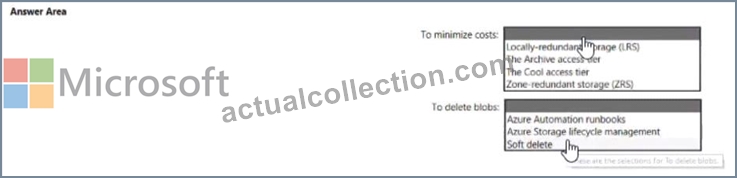
Answer:
Explanation: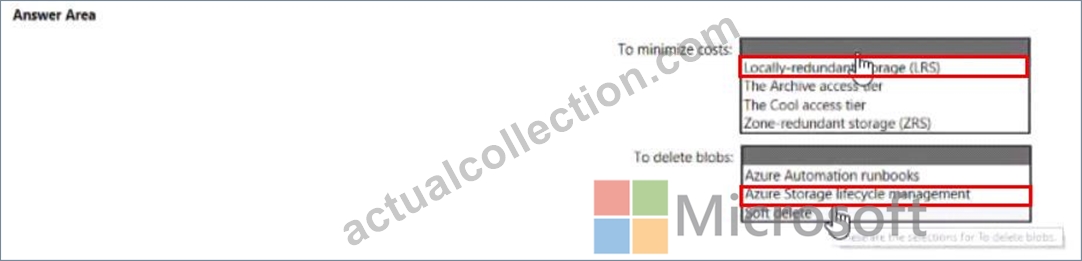
NEW QUESTION # 87
You have an Azure Data Lake Storage Gen 2 account named storage1.
You need to recommend a solution for accessing the content in storage1. The solution must meet the following requirements:
List and read permissions must be granted at the storage account level.
Additional permissions can be applied to individual objects in storage1.
Security principals from Microsoft Azure Active Directory (Azure AD), part of Microsoft Entra, must be used for authentication.
What should you use? To answer, drag the appropriate components to the correct requirements. Each component may be used once, more than once, or not at all. You may need to drag the split bar between panes or scroll to view content.
NOTE: Each correct selection is worth one point.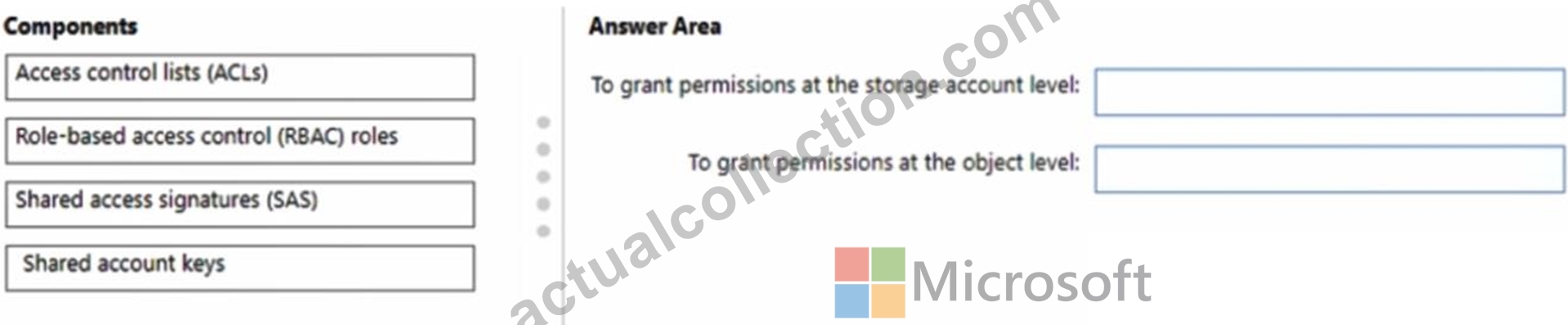
Answer:
Explanation: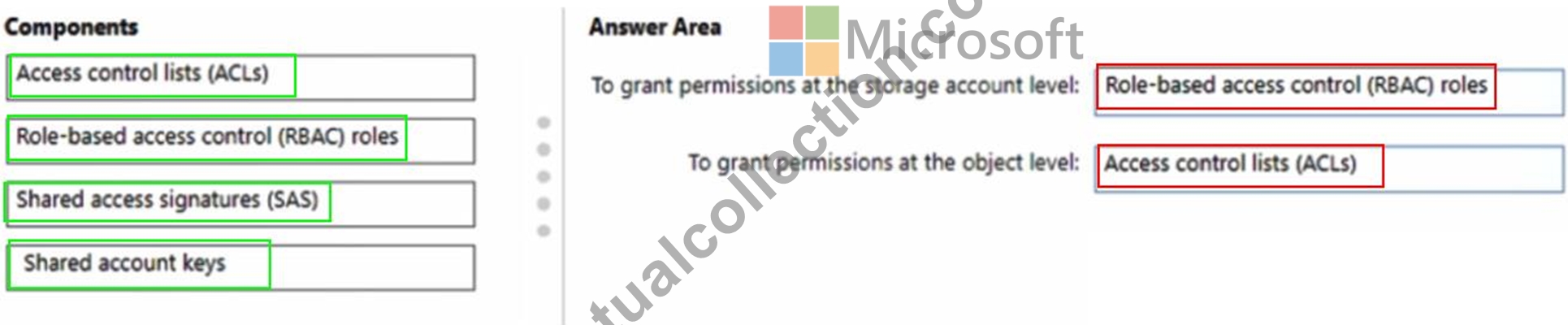
NEW QUESTION # 88
You have the following table named Employees.
You need to calculate the employee_type value based on the hire_date value.
How should you complete the Transact-SQL statement? To answer, drag the appropriate values to the correct targets. Each value may be used once, more than once, or not at all. You may need to drag the split bar between panes or scroll to view content.
NOTE: Each correct selection is worth one point.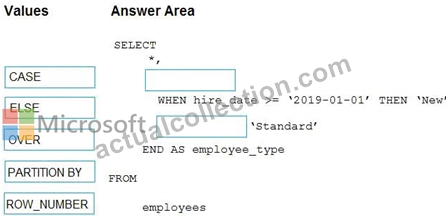
Answer:
Explanation: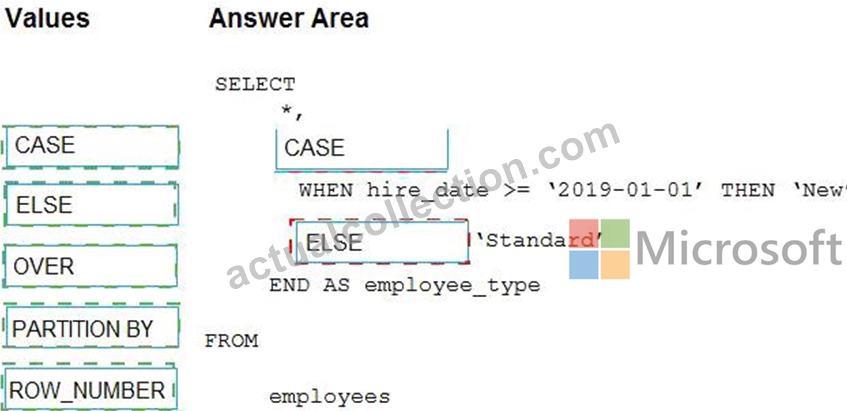
Explanation
Graphical user interface, text, application Description automatically generated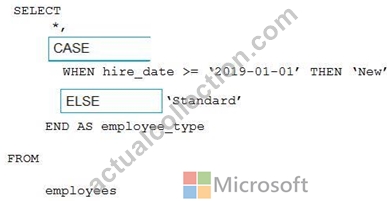
Box 1: CASE
CASE evaluates a list of conditions and returns one of multiple possible result expressions.
CASE can be used in any statement or clause that allows a valid expression. For example, you can use CASE in statements such as SELECT, UPDATE, DELETE and SET, and in clauses such as select_list, IN, WHERE, ORDER BY, and HAVING.
Syntax: Simple CASE expression:
CASE input_expression
WHEN when_expression THEN result_expression [ ...n ]
[ ELSE else_result_expression ]
END
Box 2: ELSE
Reference:
https://docs.microsoft.com/en-us/sql/t-sql/language-elements/case-transact-sql
NEW QUESTION # 89
A company uses Azure Stream Analytics to monitor devices.
The company plans to double the number of devices that are monitored.
You need to monitor a Stream Analytics job to ensure that there are enough processing resources to handle the additional load.
Which metric should you monitor?
- A. Watermark delay
- B. Early Input Events
- C. Input Deserialization Errors
- D. Late Input Events
Answer: A
Explanation:
There are a number of resource constraints that can cause the streaming pipeline to slow down. The watermark delay metric can rise due to:
Not enough processing resources in Stream Analytics to handle the volume of input events.
Not enough throughput within the input event brokers, so they are throttled.
Output sinks are not provisioned with enough capacity, so they are throttled. The possible solutions vary widely based on the flavor of output service being used.
Reference:
https://docs.microsoft.com/en-us/azure/stream-analytics/stream-analytics-time-handling
NEW QUESTION # 90
You have an Azure subscription that contains an Azure Synapse Analytics dedicated SQL pool named SQLPool1.
SQLPool1 is currently paused.
You need to restore the current state of SQLPool1 to a new SQL pool.
What should you do first?
- A. Create a workspace.
- B. Resume SQLPool1.
- C. Create a new SQL pool.
- D. Create a user-defined restore point.
Answer: D
Explanation:
Reference:
https://docs.microsoft.com/en-us/azure/synapse-analytics/sql-data-warehouse/sql-data-warehouse-restore-active-
NEW QUESTION # 91
You have a SQL pool in Azure Synapse.
You plan to load data from Azure Blob storage to a staging table. Approximately 1 million rows of data will be loaded daily. The table will be truncated before each daily load.
You need to create the staging table. The solution must minimize how long it takes to load the data to the staging table.
How should you configure the table? To answer, select the appropriate options in the answer area.
NOTE: Each correct selection is worth one point.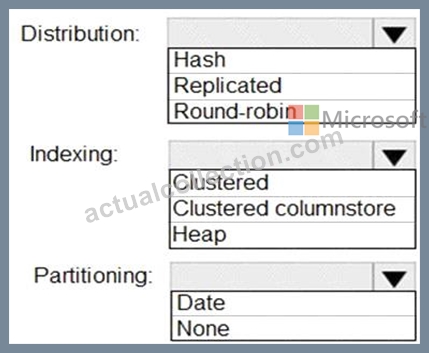
Answer:
Explanation: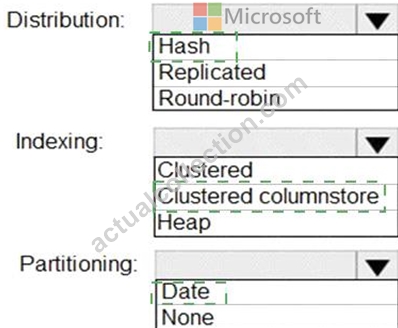
Explanation
Graphical user interface, application, table Description automatically generated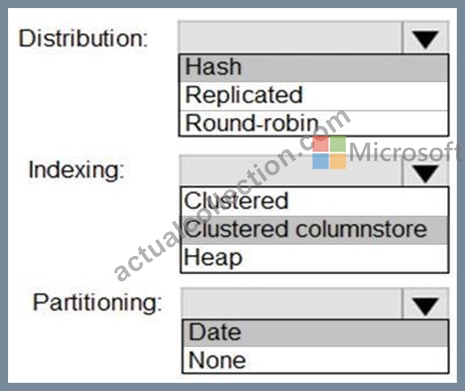
Box 1: Hash
Hash-distributed tables improve query performance on large fact tables. They can have very large numbers of rows and still achieve high performance.
Box 2: Clustered columnstore
When creating partitions on clustered columnstore tables, it is important to consider how many rows belong to each partition. For optimal compression and performance of clustered columnstore tables, a minimum of 1 million rows per distribution and partition is needed.
Box 3: Date
Table partitions enable you to divide your data into smaller groups of data. In most cases, table partitions are created on a date column.
Partition switching can be used to quickly remove or replace a section of a table.
Reference:
https://docs.microsoft.com/en-us/azure/synapse-analytics/sql-data-warehouse/sql-data-warehouse-tables-partition
https://docs.microsoft.com/en-us/azure/synapse-analytics/sql-data-warehouse/sql-data-warehouse-tables-distribu
NEW QUESTION # 92
You are developing an Azure Synapse Analytics pipeline that will include a mapping data flow named Dataflow1. Dataflow1 will read customer data from an external source and use a Type 1 slowly changing dimension (SCO) when loading the data into a table named DimCustomer1 in an Azure Synapse Analytics dedicated SQL pool.
You need to ensure that Dataflow1 can perform the following tasks:
* Detect whether the data of a given customer has changed in the DimCustomer table.
* Perform an upsert to the DimCustomer table.
Which type of transformation should you use for each task? To answer, select the appropriate options in the answer area NOTE; Each correct selection is worth one point.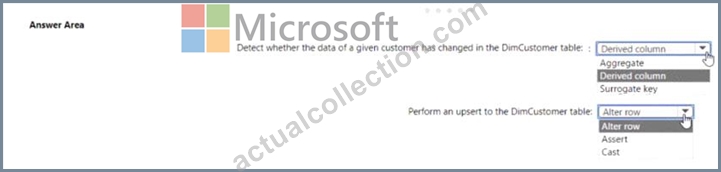
Answer:
Explanation: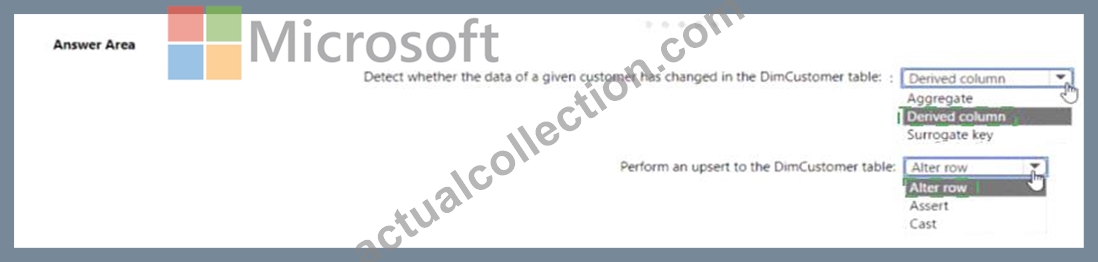
Explanation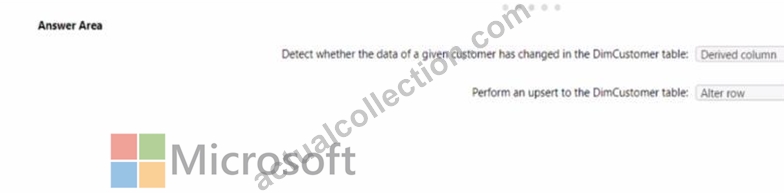
NEW QUESTION # 93
You are designing an application that will use an Azure Data Lake Storage Gen 2 account to store petabytes of license plate photos from toll booths. The account will use zone-redundant storage (ZRS).
You identify the following usage patterns:
* The data will be accessed several times a day during the first 30 days after the data is created. The data must meet an availability SU of 99.9%.
* After 90 days, the data will be accessed infrequently but must be available within 30 seconds.
* After 365 days, the data will be accessed infrequently but must be available within five minutes.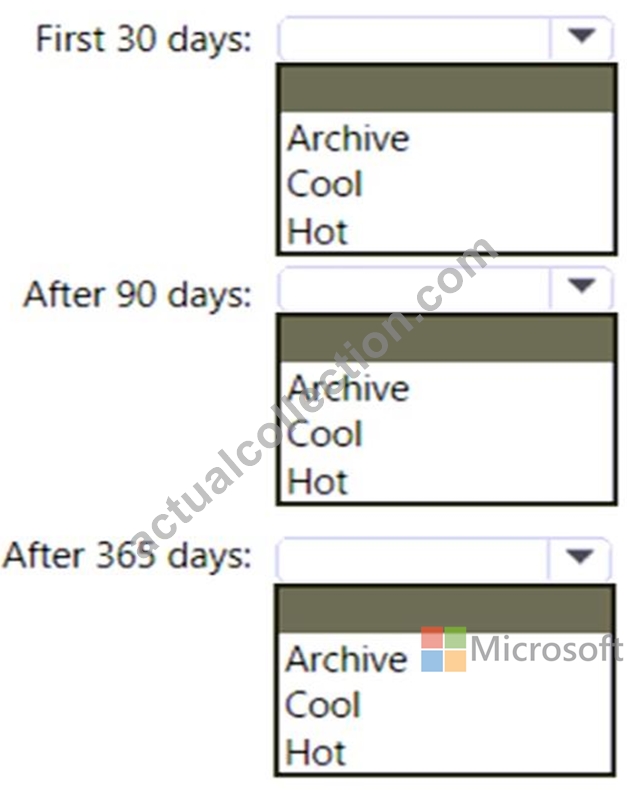
Answer:
Explanation: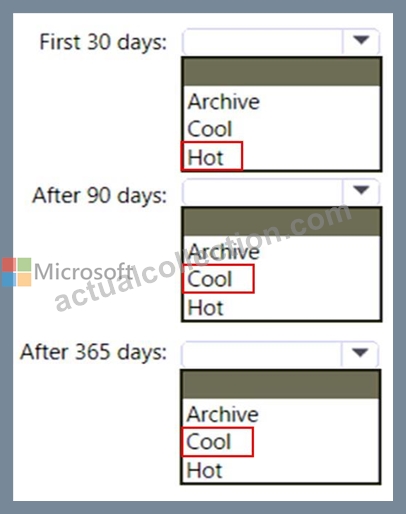
Reference:
https://docs.microsoft.com/en-us/azure/storage/blobs/archive-rehydrate-overview
NEW QUESTION # 94
You need to design a data ingestion and storage solution for the Twitter feeds. The solution must meet the customer sentiment analytics requirements.
What should you include in the solution? To answer, select the appropriate options in the answer area NOTE: Each correct selection b worth one point.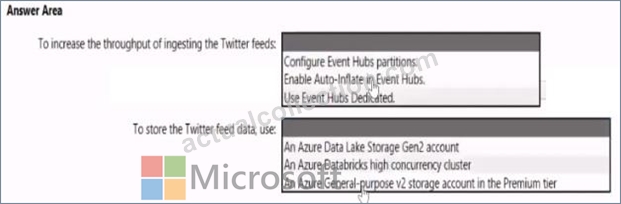
Answer:
Explanation:
Reference:
https://docs.microsoft.com/en-us/azure/event-hubs/event-hubs-features
https://docs.microsoft.com/en-us/azure/storage/blobs/data-lake-storage-access-control
NEW QUESTION # 95
You need to trigger an Azure Data Factory pipeline when a file arrives in an Azure Data Lake Storage Gen2 container.
Which resource provider should you enable?
- A. Microsoft.Sql
- B. Microsoft.EventHub
- C. Microsoft-Automation
- D. Microsoft.EventGrid
Answer: D
Explanation:
Explanation
Event-driven architecture (EDA) is a common data integration pattern that involves production, detection, consumption, and reaction to events. Data integration scenarios often require Data Factory customers to trigger pipelines based on events happening in storage account, such as the arrival or deletion of a file in Azure Blob Storage account. Data Factory natively integrates with Azure Event Grid, which lets you trigger pipelines on such events.
Reference:
https://docs.microsoft.com/en-us/azure/data-factory/how-to-create-event-trigger
https://docs.microsoft.com/en-us/azure/data-factory/concepts-pipeline-execution-triggers
NEW QUESTION # 96
You are building an Azure Data Factory solution to process data received from Azure Event Hubs, and then ingested into an Azure Data Lake Storage Gen2 container.
The data will be ingested every five minutes from devices into JSON files. The files have the following naming pattern.
/{deviceType}/in/{YYYY}/{MM}/{DD}/{HH}/{deviceID}_{YYYY}{MM}{DD}HH}{mm}.json You need to prepare the data for batch data processing so that there is one dataset per hour per deviceType.
The solution must minimize read times.
How should you configure the sink for the copy activity? To answer, select the appropriate options in the answer area.
NOTE: Each correct selection is worth one point.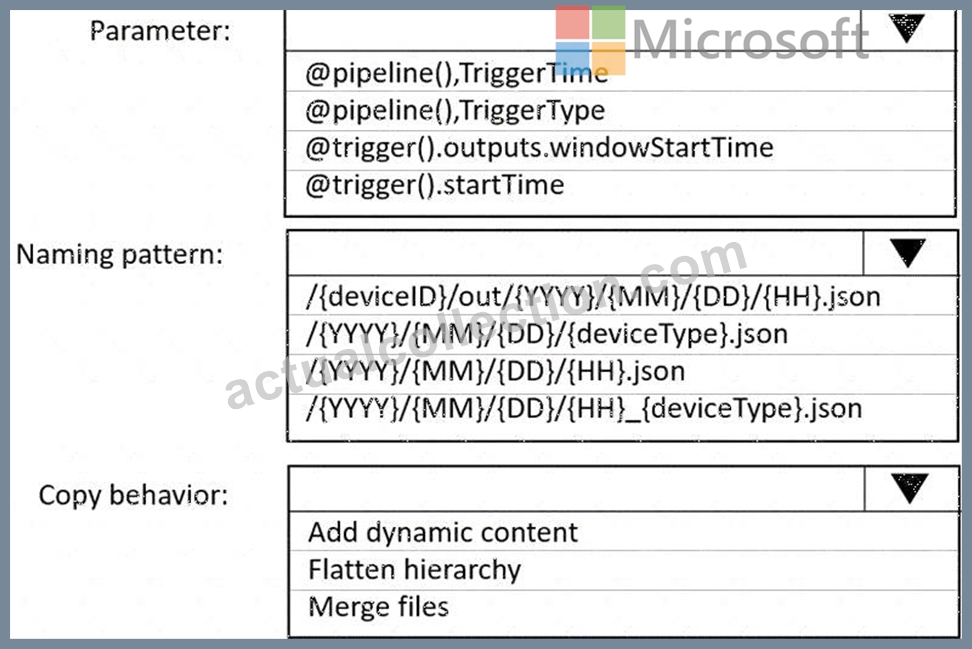
Answer:
Explanation: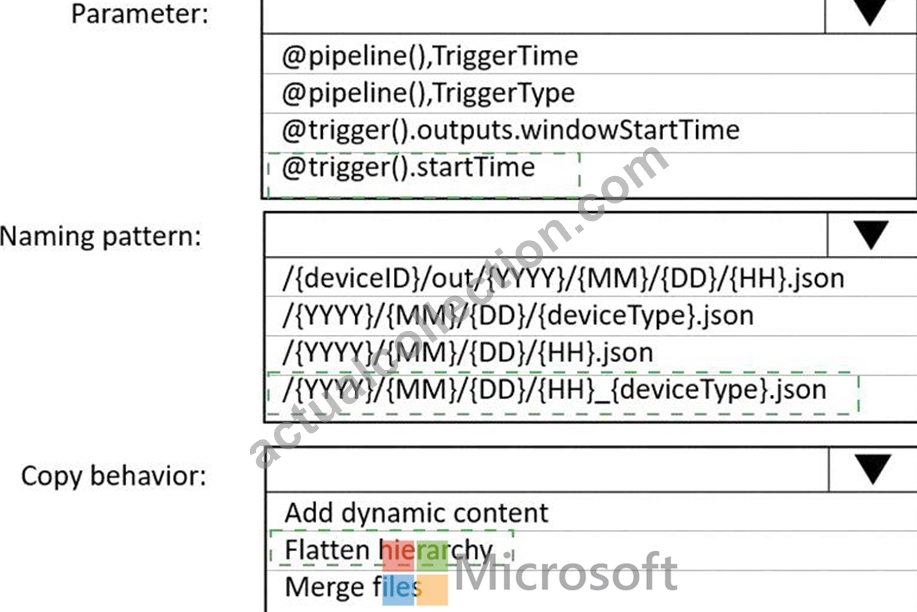
Explanation
Box 1: @trigger().startTime
startTime: A date-time value. For basic schedules, the value of the startTime property applies to the first occurrence. For complex schedules, the trigger starts no sooner than the specified startTime value.
Box 2: /{YYYY}/{MM}/{DD}/{HH}_{deviceType}.json
One dataset per hour per deviceType.
Box 3: Flatten hierarchy
- FlattenHierarchy: All files from the source folder are in the first level of the target folder. The target files have autogenerated names.
Reference:
https://docs.microsoft.com/en-us/azure/data-factory/concepts-pipeline-execution-triggers
https://docs.microsoft.com/en-us/azure/data-factory/connector-file-system
NEW QUESTION # 97
You are responsible for providing access to an Azure Data Lake Storage Gen2 account.
Your user account has contributor access to the storage account, and you have the application ID and access key.
You plan to use PolyBase to load data into an enterprise data warehouse in Azure Synapse Analytics.
You need to configure PolyBase to connect the data warehouse to storage account.
Which three components should you create in sequence? To answer, move the appropriate components from the list of components to the answer area and arrange them in the correct order.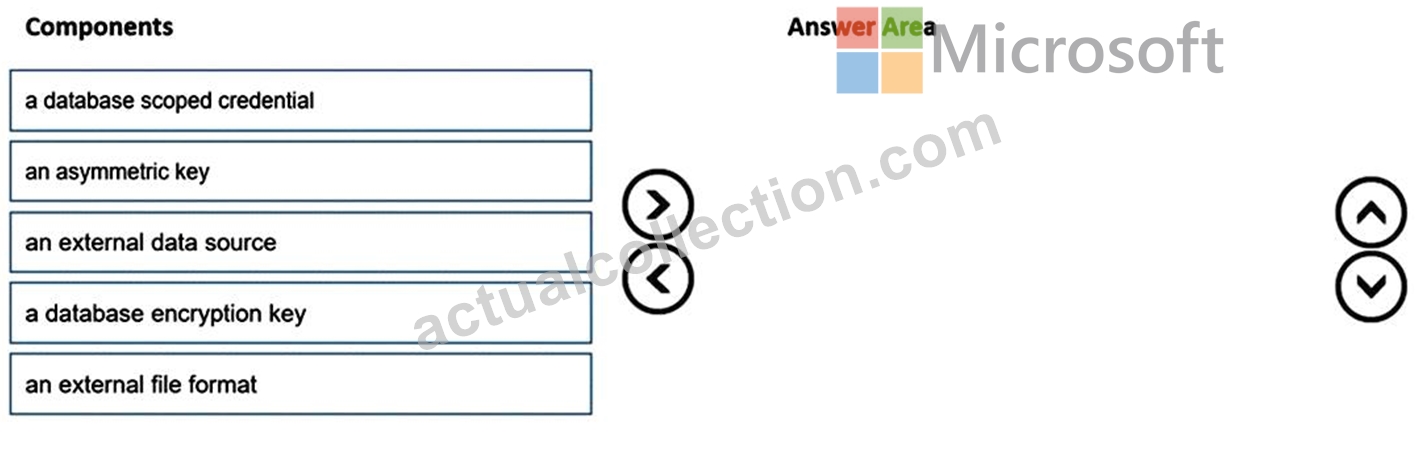
Answer:
Explanation: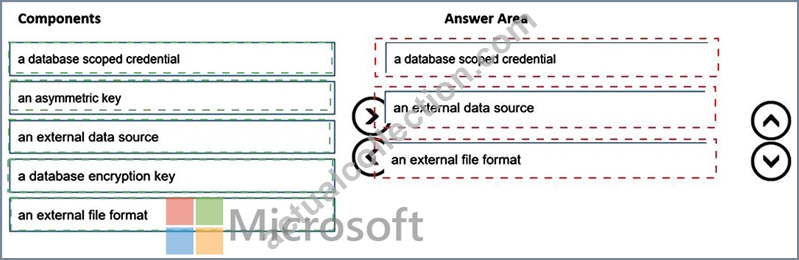
Explanation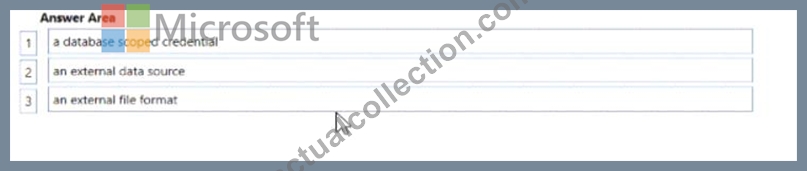
NEW QUESTION # 98
You have a data model that you plan to implement in a data warehouse in Azure Synapse Analytics as shown in the following exhibit.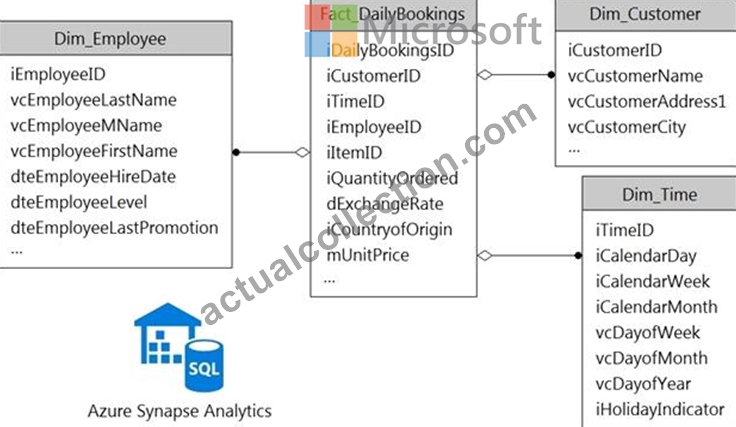
All the dimension tables will be less than 2 GB after compression, and the fact table will be approximately 6 TB.
Which type of table should you use for each table? To answer, select the appropriate options in the answer are a.
NOTE: Each correct selection is worth one point.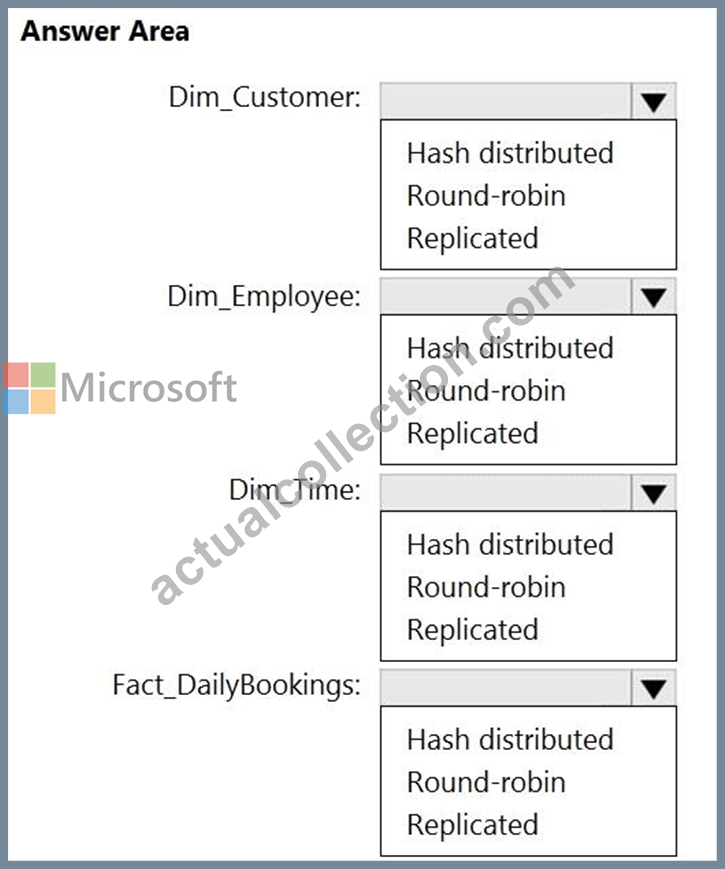
Answer:
Explanation: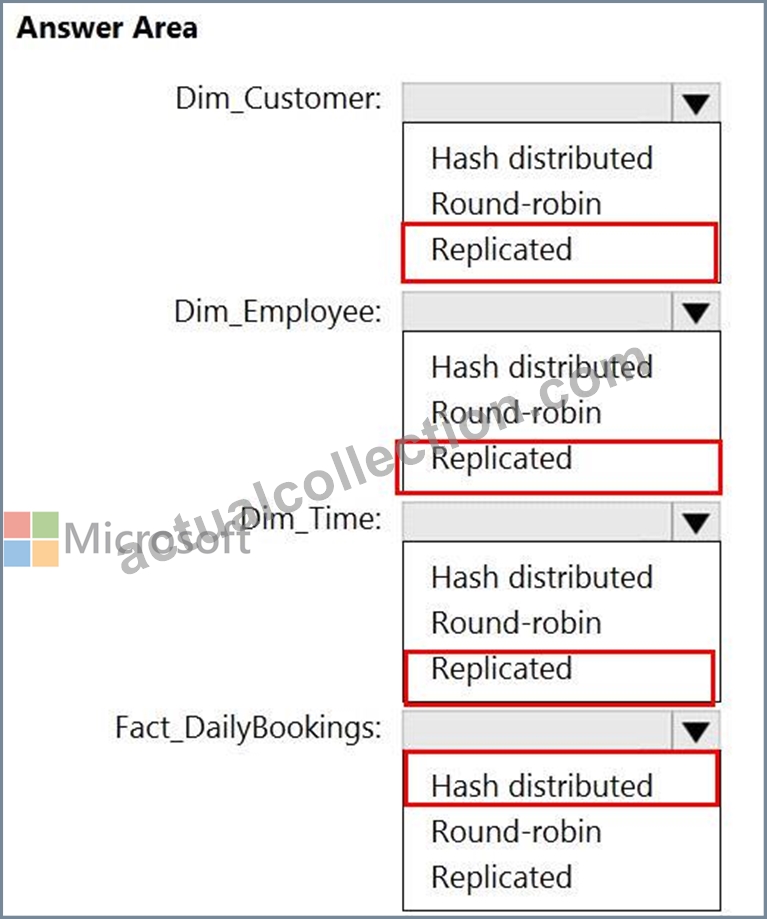
NEW QUESTION # 99
You are building an Azure Data Factory solution to process data received from Azure Event Hubs, and then ingested into an Azure Data Lake Storage Gen2 container.
The data will be ingested every five minutes from devices into JSON files. The files have the following naming pattern.
/{deviceType}/in/{YYYY}/{MM}/{DD}/{HH}/{deviceID}_{YYYY}{MM}{DD}HH}{mm}.json You need to prepare the data for batch data processing so that there is one dataset per hour per deviceType. The solution must minimize read times.
How should you configure the sink for the copy activity? To answer, select the appropriate options in the answer area.
NOTE: Each correct selection is worth one point.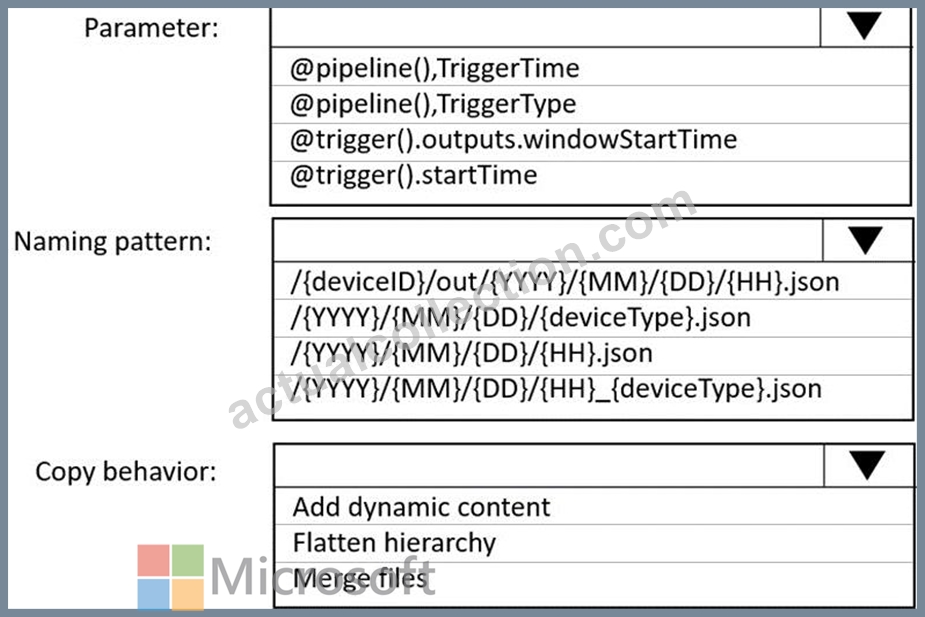
Answer:
Explanation: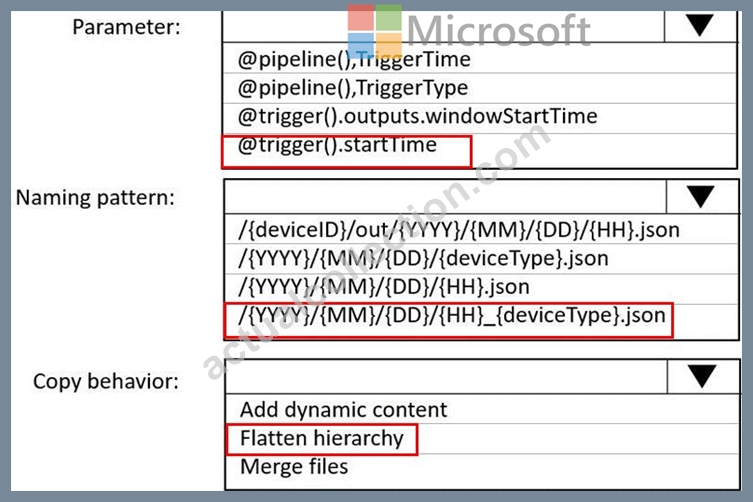
Reference:
https://docs.microsoft.com/en-us/azure/data-factory/concepts-pipeline-execution-triggers
https://docs.microsoft.com/en-us/azure/data-factory/connector-file-system
NEW QUESTION # 100
Which Azure Data Factory components should you recommend using together to import the daily inventory data from the SQL server to Azure Data Lake Storage? To answer, select the appropriate options in the answer area.
NOTE: Each correct selection is worth one point.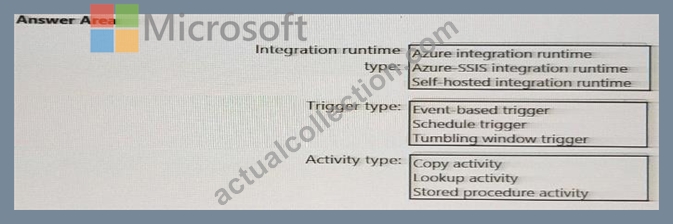
Answer:
Explanation: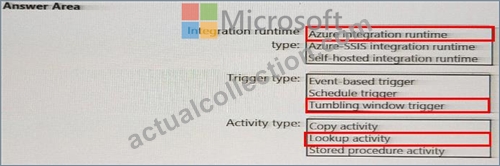
NEW QUESTION # 101
You have an Azure Synapse Analytics pipeline named Pipeline1 that contains a data flow activity named Dataflow1.
Pipeline1 retrieves files from an Azure Data Lake Storage Gen 2 account named storage1.
Dataflow1 uses the AutoResolveIntegrationRuntime integration runtime configured with a core count of 128.
You need to optimize the number of cores used by Dataflow1 to accommodate the size of the files in storage1.
What should you configure? To answer, select the appropriate options in the answer area.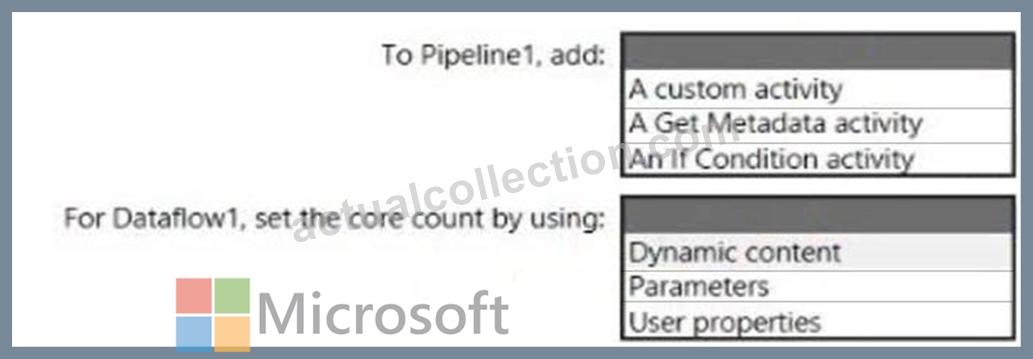
Answer:
Explanation: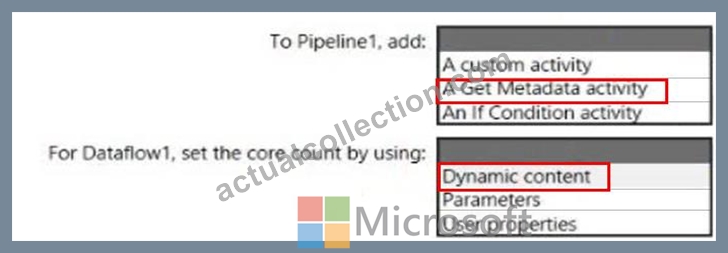
NEW QUESTION # 102
You are designing a highly available Azure Data Lake Storage solution that will induce geo-zone-redundant storage (GZRS).
You need to monitor for replication delays that can affect the recovery point objective (RPO).
What should you include m the monitoring solution?
- A. availability
- B. Error errors
- C. Average Success Latency
- D. Last Sync Time
Answer: D
Explanation:
Because geo-replication is asynchronous, it is possible that data written to the primary region has not yet been written to the secondary region at the time an outage occurs. The Last Sync Time property indicates the last time that data from the primary region was written successfully to the secondary region. All writes made to the primary region before the last sync time are available to be read from the secondary location. Writes made to the primary region after the last sync time property may or may not be available for reads yet.
Reference:
https://docs.microsoft.com/en-us/azure/storage/common/last-sync-time-get
NEW QUESTION # 103
......
What should I know before taking the Microsoft DP-203 exam?
Microsoft offers Data Engineering on Microsoft Azure certification to those who wish to demonstrate their knowledge of data engineering on the Microsoft Cloud. The exam comprises multiple-choice questions, and each question is worth one mark. The candidates are required to attempt 60 questions in total, i.e., within 130 minutes. In order to take this exam, the candidates are required to have knowledge of the fundamental concepts related to the subject matter. Knowledge of basic cloud computing concepts (such as virtual machines, virtual networks, etc.) would be beneficial for the candidates. Microsoft DP-203 exam dumps contains an online study guide that explains all the concepts and answers to practice questions. Candidates should try to understand the concepts completely to gain good marks on the test.
Pass Your Microsoft Exam with DP-203 Exam Dumps: https://quizguide.actualcollection.com/DP-203-exam-questions.html